1-415-230-4353

The Juniper QFX5200-32C: One Switch, a Surprising Number of Possibilities
By admin on 10 Nov 2026
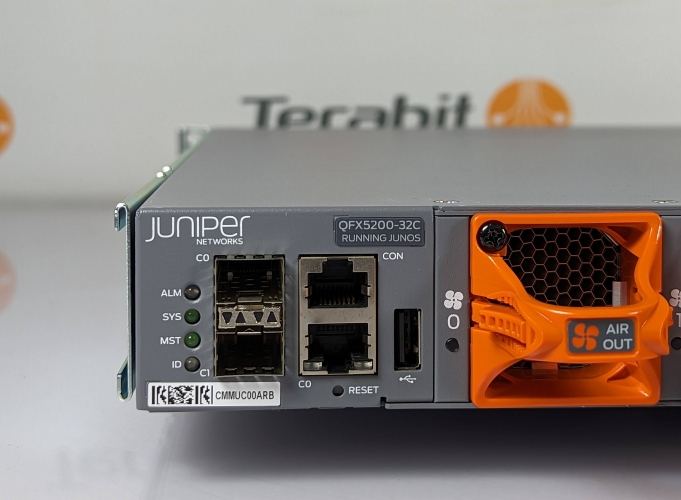
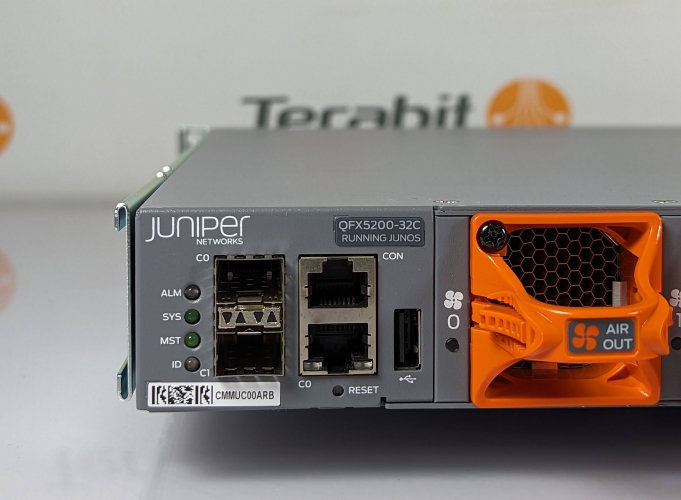
Why this 32-port powerhouse should show up on your network equipment shopping list.
There are plenty of switches that can move traffic at 100Gbps. What's interesting about the Juniper QFX5200-32C is how many different jobs it can do.
Need 32 ports of 100G? You've got them. Need to connect a large number of 25G servers? That works too. Still operating a mix of 10G and 40G equipment? The QFX5200 can accommodate those connections as well.
That versatility is a big part of the QFX5200-32C's appeal. It's not simply a fast switch. It's a flexible piece of data center infrastructure that can be put to work in several different ways.
And as these switches have become more accessible on the secondary market, they're worth a closer look.
It's Really About the Ports
The QFX5200-32C packs 32 QSFP28 ports into a single rack unit, providing up to 3.2 Tbps of unidirectional switching capacity, or 6.4 Tbps bidirectional.
That's impressive, but the interesting part is what you can do with those ports.
Each 100G port can be configured to support two 50G or four 25G connections using appropriate breakout cables. Alternatively, ports configured for 40G can be broken out into four 10G connections.
Do the math, and a single QFX5200-32C can support as many as 128 logical 25G or 10G connections.
For an operator building a server cluster, expanding a virtualization environment, or connecting racks of equipment with different interface speeds, that's a useful capability.
Instead of selecting a switch exclusively around today's port requirements, network architects have some room to accommodate changes in their infrastructure.
The 25G Connection Is Especially Interesting
One reason to pay attention to the QFX5200 is its ability to accommodate 25GbE connectivity.
Twenty-five gigabit Ethernet is a natural step up for servers that have outgrown 10G connections but don't require dedicated 100G interfaces.
The QFX5200-32C can provide 25G server-facing connectivity through breakout cables while preserving the ability to configure other ports for higher-speed connections.
This is useful in environments where server upgrades happen gradually.
A rack might contain older 10G systems, newer servers with 25G network adapters, and storage or aggregation equipment operating at 100G.
The QFX5200 gives network engineers several ways to accommodate that mix, although the physical cabling and port configurations need to be planned carefully.
A Practical Fit for Leaf-and-Spine Networks
The QFX5200 was designed for modern data center fabrics, particularly leaf-and-spine architectures where predictable performance and high-speed connections are essential.
Its low-latency forwarding and high port density make it useful for connecting servers, storage platforms, and other switches.
It also supports established networking technologies including Layer 2 switching, Layer 3 routing, and features commonly used in data center fabrics.
For organizations already running Juniper infrastructure, there's the added advantage of Junos.
Network administrators can take advantage of familiar configuration, monitoring, and automation tools rather than introducing an entirely unfamiliar operating environment.
That's not necessarily a reason to choose the QFX5200 on its own, but it can make deployment and ongoing support easier.
Don't Overlook the Physical Details
Sometimes the practical features matter just as much as the headline specifications.
The QFX5200-32C occupies only 1RU, includes redundant power supplies and fans, and is available in different airflow configurations.
For a crowded data center rack, that combination matters.
Airflow direction is particularly important when purchasing refurbished equipment. The wrong configuration can create cooling problems, even when the switch otherwise meets every technical requirement. Terabit can usually supply both airflow options.
It's also worth checking the specific optics, breakout cables, software release, and licensing requirements before purchasing.
The QFX5200 is not a universal solution. Its relatively shallow packet buffer, for example, deserves attention in networks with significant congestion or burst-heavy traffic.
But in an appropriately designed environment, it can handle a substantial amount of high-speed connectivity without consuming much rack space.
So Why the Interest in the QFX5200-32C?
It's the combination of capabilities that makes this model interesting.
A single switch can support a dense group of 100G connections, provide breakout connectivity for 25G servers, accommodate existing 10G and 40G equipment, or serve as part of a larger switching fabric.
That's a lot of utility from one box.
And with refurbished units available through the secondary market, network operators have an opportunity to put those capabilities to work without necessarily purchasing new equipment.
There's no magic here. The QFX5200 has been around for years, and newer switches offer capabilities it doesn't have.
But the hardware remains useful, the port configurations are unusually versatile, and the deployment possibilities extend well beyond simply connecting 32 devices at 100G.
Sometimes a switch becomes more interesting as the number of ways to use it grows.
At Terabit Systems, we supply tested, refurbished Juniper QFX5200-32C switches and can help customers identify the appropriate model, airflow configuration, optics, and accessories for their application.
Whether you're adding 100G connectivity, expanding a 25G server environment, or maintaining an existing Juniper data center fabric, contact us for a quote, or call +1 (415) 230-4353.
November 10, 2026
Contact Us
Terabit Systems
2565 3rd Street #218
San Francisco, CA. 94107
2565 3rd Street #218
San Francisco, CA. 94107
1-415-230-4353