1-415-230-4353

Juniper MX10003 vs MX480, MX960, MX204, and MX304: Where Does It Really Fit?
By admin on 02 Mar 2026
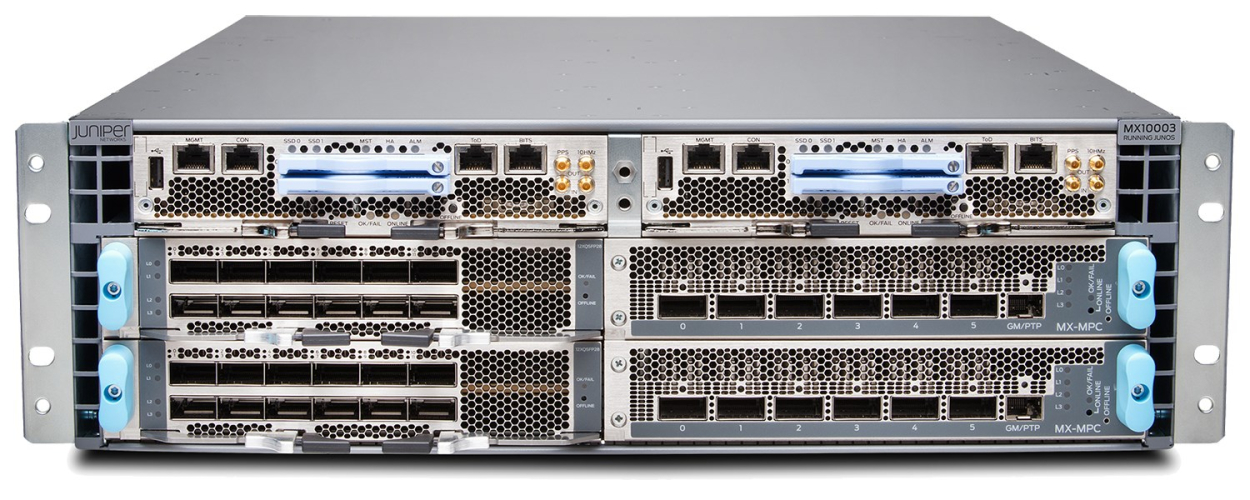
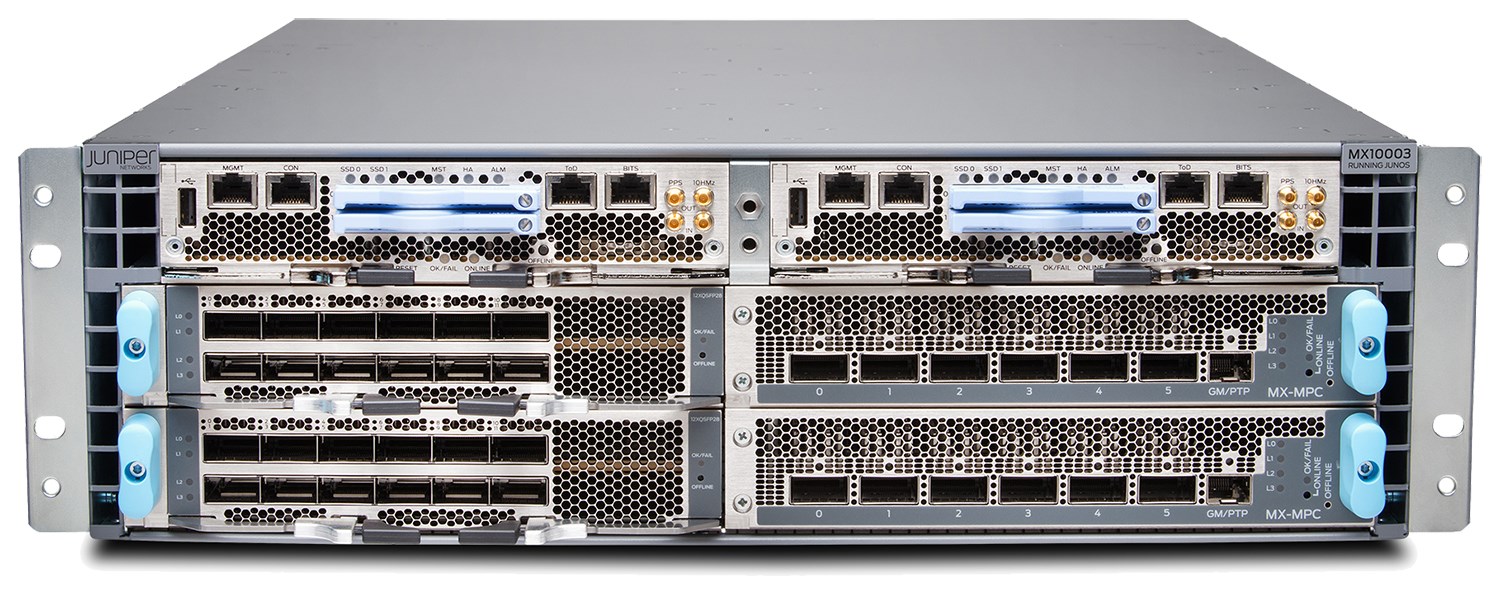
When customers call Terabit Systems asking about the Juniper Networks MX10003, the next question is almost always the same:
Is this closer to an MX480 or MX960, or is it more like an MX204 or MX304?
Here’s an overview of the Juniper MX10003 Router — a high-performance edge router platform from Juniper Networks designed for service providers, cloud networks, and large enterprise environments, followed by a comparison with its related MX products.
What It Is
The MX10003 Universal Routing Platform is part of Juniper’s MX Series of universal edge routers. It’s built to handle heavy traffic loads at the network edge — such as broadband aggregation, 5G backhaul, cloud connectivity, and large-scale enterprise VPNs — in a compact chassis with high throughput and interface density.
Key Capabilities
High Throughput & Density
- Delivers up to 2.4 Tbps of system capacity in a 3-rack-unit (3 RU) chassis.
- Supports a range of interface options — e.g., high-density 10 GbE, 40 GbE, and 100 GbE ports — making it suitable for dense edge deployments.
Space- & Power-Optimized
- Designed to be energy efficient and compact, balancing performance with a smaller footprint.
Carrier-Grade Reliability
- Redundant control plane and N+1 power supply redundancy help ensure high availability.
- Runs on Juniper’s Junos OS, a modular and carrier-grade routing operating system common across Juniper routers.
Advanced Networking Features
- Supports services like IP transport, VPNs, L3VPN, BNG (broadband network gateway), and Metro Ethernet.
- Offers rich automation, telemetry, and timing features for modern network management.
- Can be part of Virtual Chassis technology to manage two systems as one logical router.
Physical & Environmental
- Dimensions: About 3 RU high (~5.2 in × 30 in × 19 in).
- Weight: Roughly ~120 lbs (≈54 kg).
- Cooling: Front-to-back airflow designed for rack deployment.
Deployment Use Cases
The MX10003 is often used for:
- Service provider edge routing and broadband aggregation
- Mobile network cores & 5G transport
- Cloud and data center edge interconnects
- Large enterprise WAN edge
- Metro Ethernet and VPN services
Behind the Platform
Juniper leverages its programmable Trio chipset in the MX10003 — a silicon family designed to support high-scale routing, switching, and service features — which allows flexible interfaces and capabilities using modular port cards.
Variations / Options
There are base vs. enhanced chassis options (e.g., Premium versions with more routing engines or higher throughput claims in some refurbished/third-party listings), but the core platform remains the high-density 3 RU MX10003 router for edge networks.
How does the MX10003 compare to the earlier MX480 and MX960? Or is it closer to the MX204 and MX304?
Here’s how the Juniper Networks MX10003 stacks up against the other members of the MX Series — especially the older MX480/MX960 modular chassis platforms versus the smaller fixed-configuration models like the MX204/MX304:
How the MX10003 Fits in the MX Series Lineup
Architecture & Scale
MX10003
- Compact, 3 RU Universal Routing Platform with very high density and throughput suited for edge routing and cloud/data-center interconnect.
- Designed as a high-capacity edge router that bridges the gap between fixed-configuration small boxes and larger modular carriers.
Comparison: MX10003 vs. Modular Chassis (MX480 & MX960)
|
Feature |
MX10003 |
MX480 |
MX960 |
|---|---|---|---|
|
Throughput (approx) |
~2.4 Tbps |
~7–7.5 Tbps |
~12 Tbps |
|
Chassis |
3 RU compact |
8 RU modular |
16 RU modular |
|
Slot-based MPC cards |
No (fixed or limited expansion) |
Yes (6 slots) |
Yes (11 slots) |
|
Typical Use |
High-density edge, peering, DC interconnect |
High-end edge/core |
Very high capacity core/edge |
|
Modular/shelf architecture |
✖ |
✔ |
✔ |
Modular chassis (MX480/MX960) scale far higher in raw capacity and interface expansion — they use MPC/DPC cards and support multi-terabit scale well beyond what a compact fixed box can handle. These are traditionally used deeper in provider networks and large enterprise cores.
Conclusion:
- The MX10003 sits well below the MX480/MX960 in total capacity and modular expandability. It’s not a direct replacement for those big carriers in terms of throughput.
- Instead it targets edge and data-center use cases where space, power, and cost efficiency matter more than maximum slot count or absolute scale.
- Think of MX480/MX960 as large modular routers for massive service provider backbone/edge sites, while MX10003 is a compact high-density edge platform.
Comparison: MX10003 vs. Smaller Fixed Platforms (MX204 & MX304)
|
Feature |
MX10003 |
MX304 |
MX204 |
|---|---|---|---|
|
Throughput (approx) |
~2.4 Tbps |
~4.8 Tbps |
~0.4–1.44 Tbps (varies by source) |
|
Chassis |
3 RU compact |
2 RU |
1 RU |
|
Port Density |
Very high |
Very high |
High |
|
Fixed vs Modular |
Fixed |
Modular-ish card support |
Fixed |
- MX204 is a very small fixed router optimized for dense 10/25/40/100 GbE at edge peering and WAN aggregation with hundreds of gigabits of forwarding capacity.
- MX304 is a beefier fixed/modular hybrid (2 RU, up to ~4.8 Tbps), offering more scale and density than the MX204.
- The MX10003 sits above the MX204 in throughput and edge capability but generally below the MX304’s highest system capacity.
Wrap Up:
- The MX10003 is closer in role to the MX204/MX304 than to the big modular MX480/MX960, because it’s designed as a compact high-density edge router rather than a large modular aggregation/core chassis.
- However, it’s significantly more capable than the MX204 in throughput and density but less than the MX304’s top capacity.
Summary
- MX480 & MX960: Large modular platforms built for maximum scale, slot capacity, and carrier provider backbone/edge aggregation.
- MX304: A mid-range, compact but still high-capacity platform bridging small fixed routers and modular chassis.
- MX10003: Sits between the smallest fixed boxes (like MX204) and the higher throughput MX304; it’s a compact but very capable edge router, ideal for high-density environments where chassis modularity isn’t needed.
- MX204: Entry-level high-density edge router with lower overall throughput and smaller fixed configuration.
The MX10003 is closer to the MX204/MX304 class in terms of its role and deployment profile, but with significantly higher performance than the MX204, and not as massive a platform as the modular MX480/MX960.
Ready to talk? Just click here to email a Terabit rep today or call +1 (415) 230-4353 to talk with a smart rep.
March 02, 2026
Contact Us
Terabit Systems
2565 3rd Street #218
San Francisco, CA. 94107
2565 3rd Street #218
San Francisco, CA. 94107
1-415-230-4353