1-415-230-4353

Your Next Network Refresh: Why It’s Less About Speed and More About Efficiency
By admin on 21 Aug 2025
For the last decade, speed has been the default justification for any network refresh. Need new switches? Chase higher throughput. Upgrade the backbone? Go for 100G, maybe even 400G. But in today’s data center environment — where energy costs, staffing limitations, and hardware lifecycle all impact your bottom line — network operators are rethinking what actually matters.
More and more teams are approaching their next refresh with a new guiding principle: efficiency over raw speed.
Here’s how that shift is playing out in real-world procurement and engineering decisions — and what smart operators are prioritizing now.
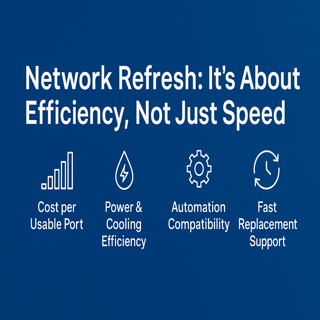
1. Cost Per Port, Not Just Port Speed
For years, spec sheets pushed buyers toward ever-higher bandwidth. But in most data centers, a large percentage of 100G-capable ports are only running at 10 or 25G — and staying that way for years. The result? Unused capacity and wasted budget.
Smart teams now benchmark hardware based on cost per usable port, taking into account:
- Actual link utilization
- Port breakout configurations (e.g., splitting 100G into 4x25G)
- Cabling costs (DACs vs. optics)
- Rack space cost per RU (especially in colocation environments)
For example, a refurbished 48-port 10G Arista switch with 6x 40G uplinks might cost 60–70% less than a newer 25G/100G model — but still meet all current requirements. If your traffic patterns are stable, overbuying bandwidth is just overspending.
2. Power, Cooling, and Real-Estate Efficiency
In colocation and hyperscale environments, power is often your most constrained resource — not bandwidth. According to Uptime Institute's 2024 Global Data Center Survey, over 40% of operators cited power availability as a key limit on growth.
That’s why network refreshes are now evaluating:
- Watts per Gbps (energy efficiency of switching ASICs)
- Cooling load per rack (based on thermal design power)
- Space utilization (how many ports per RU)
For example, some of the newer Supermicro bare-metal switches offer 100G throughput at under 180W total draw — dramatically better than older 40G or 100G gear that can draw twice that under load. Multiply that across 10 racks, and the operational savings are substantial.
3. Automation-Ready Hardware and Operations Efficiency
Labor remains one of the most expensive and limited resources in IT. According to EMA research, network teams spend over 30% of their time on manual device provisioning and configuration.
Efficiency today isn’t just electrical — it’s operational. Choosing switches and routers that support:
- Native API access (e.g., REST, gNMI)
- Ansible modules or Zero-Touch Provisioning (ZTP)
- Easy integration with DCIM and NMS platforms (NetBox, Grafana, etc.)
Older legacy gear may still push packets, but if it can't plug into your automation workflows, you're paying for that gap every day.
4. Reliability, Lifecycle Planning, and Replacement Assurance
Just because hardware is older doesn’t mean it’s unreliable. Many data center teams now prefer proven, previous-generation hardware that has established a track record in production environments.
What matters most is predictability — and knowing what to expect when something fails.
Every piece of hardware we ship is covered by a one-year replacement warranty, giving you confidence that your investment is protected. We maintain spare units in stock for fast advanced replacement when things go wrong — helping you keep uptime high and MTTR low without the long lead times of OEM-only support programs.
Combined with in-house testing and pre-ship validation, our replacement support structure ensures your refresh project isn’t just efficient up front — it stays reliable long after install.
Final Thoughts
Your next network refresh doesn’t have to be about chasing maximum speeds. It can be about deploying the right speed, at the right cost, with the lowest long-term overhead.
At Terabit Systems, we work with teams building for the long haul — not just for the spec sheet. Whether you’re upgrading your spine-leaf architecture, rebuilding your aggregation layer, or deploying new edge capacity, we’ll help you find gear that delivers real-world efficiency, not marketing hype.
If you’re ready to rethink how you buy — and why — we’re ready to help. Just click here to email or call +1 (415) 230-4353 to connect with a cool rep.
August 21, 2025
Contact Us
Terabit Systems
2565 3rd Street #218
San Francisco, CA. 94107
2565 3rd Street #218
San Francisco, CA. 94107
1-415-230-4353