1-415-230-4353

Designing for Failure: What Cloud Taught Us That Still Applies On-Prem
By admin on 22 Sep 2025
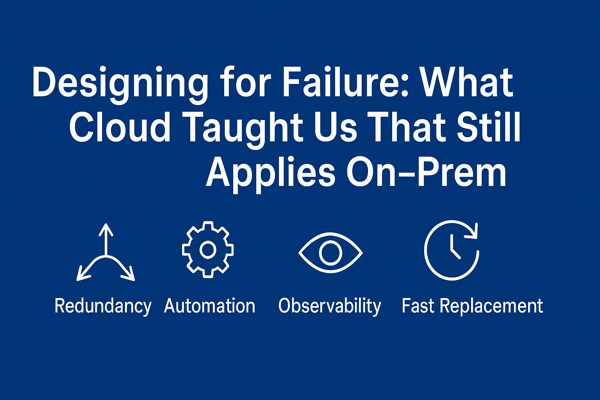
“Design for failure.” It’s one of the cloud’s most famous architectural mantras. But in 2025, it’s not just a public cloud concept — it’s the foundation of resilient infrastructure, whether you run workloads in AWS, on bare metal, or in a hybrid data center.
For network operators, engineers, and architects, the ability to design and recover from failure has become just as important as uptime itself. And while cloud-native platforms have pushed the conversation forward, many of the same principles apply — and in some ways, apply better — on-prem.
Here’s how network teams are translating cloud-born practices into the design of physical, owned infrastructure — and what lessons have stuck.
1. Redundancy Without Overbuild
One of the most enduring lessons from cloud architecture is to build for component failure — not to prevent it, but to expect it.
That doesn’t mean buying double the hardware. It means designing topologies with failure domains, using features like ECMP, MLAG, or VPC, and deploying active-active paths across devices and racks. If a top-of-rack switch fails, traffic shifts. If a supervisor goes down, the standby takes over.
With careful design, you can increase reliability without doubling spend. Terabit Systems routinely helps customers deploy Arista and Juniper topologies with built-in high availability — not overkill, just intelligent, expected resiliency.
2. Stateless Infrastructure and Automation
One reason public cloud can recover from failure so quickly is that it doesn’t rely on stateful, snowflake devices. You can kill an instance and restart it from known-good config.
That approach translates beautifully to on-prem gear: standardized golden configs, Zero-Touch Provisioning, and automation pipelines mean you don’t need to scramble when a device dies. You just reprovision, reload, and resume.
Tools like Ansible, NetBox, and even vendor-native scripting engines (like Arista’s EOS extensions) let you orchestrate recovery the same way cloud APIs do — consistently and fast.
3. Observability and Fault Tolerance at the Edge
In cloud-native design, observability is everything. If you can’t detect failure, you can’t respond to it.
Modern on-prem networks now emulate that model with high-signal SNMP traps, real-time telemetry streams, and RESTful monitoring endpoints. And with rising adoption of intent-based networking tools, ops teams can validate not just device status, but overall path health and policy enforcement.
Fault domains aren’t just a design theory anymore — they’re actively monitored and reflected in alerting and visualization tools.
4. Fail the Test Before the Test Fails You
One of the more radical lessons from cloud ops is the use of failure injection — chaos engineering — to stress-test systems in production-like conditions.
In on-prem environments, you don’t need to go full Netflix Chaos Monkey. But you can absolutely benefit from simulation and staged failover drills. Pull a link. Power off a switch. Verify your BGP reconverges and your out-of-band still works.
The goal isn’t to prove perfection — it’s to build confidence in your architecture’s ability to adapt. And every real-world failover you’ve practiced is one less fire drill during a real outage.
5. Support Models That Match the Risk
The cloud abstracts away hardware. But on-prem teams still have to think about parts, replacements, and RMA timelines.
At Terabit Systems, we mitigate that risk with a one-year replacement warranty on all refurbished gear. We maintain tested spares in stock, which means when failure happens, we can help you restore service fast — no waiting on OEM lead times or complex support escalations.
That assurance, combined with cloud-inspired design, gives our customers real-world uptime without the overhead.
Designing for failure doesn’t mean planning to fail. It means expecting the unexpected, building for it, and practicing recovery so your team performs under pressure.
Cloud changed how we think about infrastructure resilience. But the principles it introduced — modularity, observability, automation, and graceful degradation — are just as valuable on-prem.
If you’re building or refreshing infrastructure and want to adopt these best practices without the cloud bill, we’re here to help. Just click here to email a Terabit rep today or call +1 (415) 230-4353 to connect with a smart rep.
September 22, 2025
Contact Us
Terabit Systems
2565 3rd Street #218
San Francisco, CA. 94107
2565 3rd Street #218
San Francisco, CA. 94107
1-415-230-4353