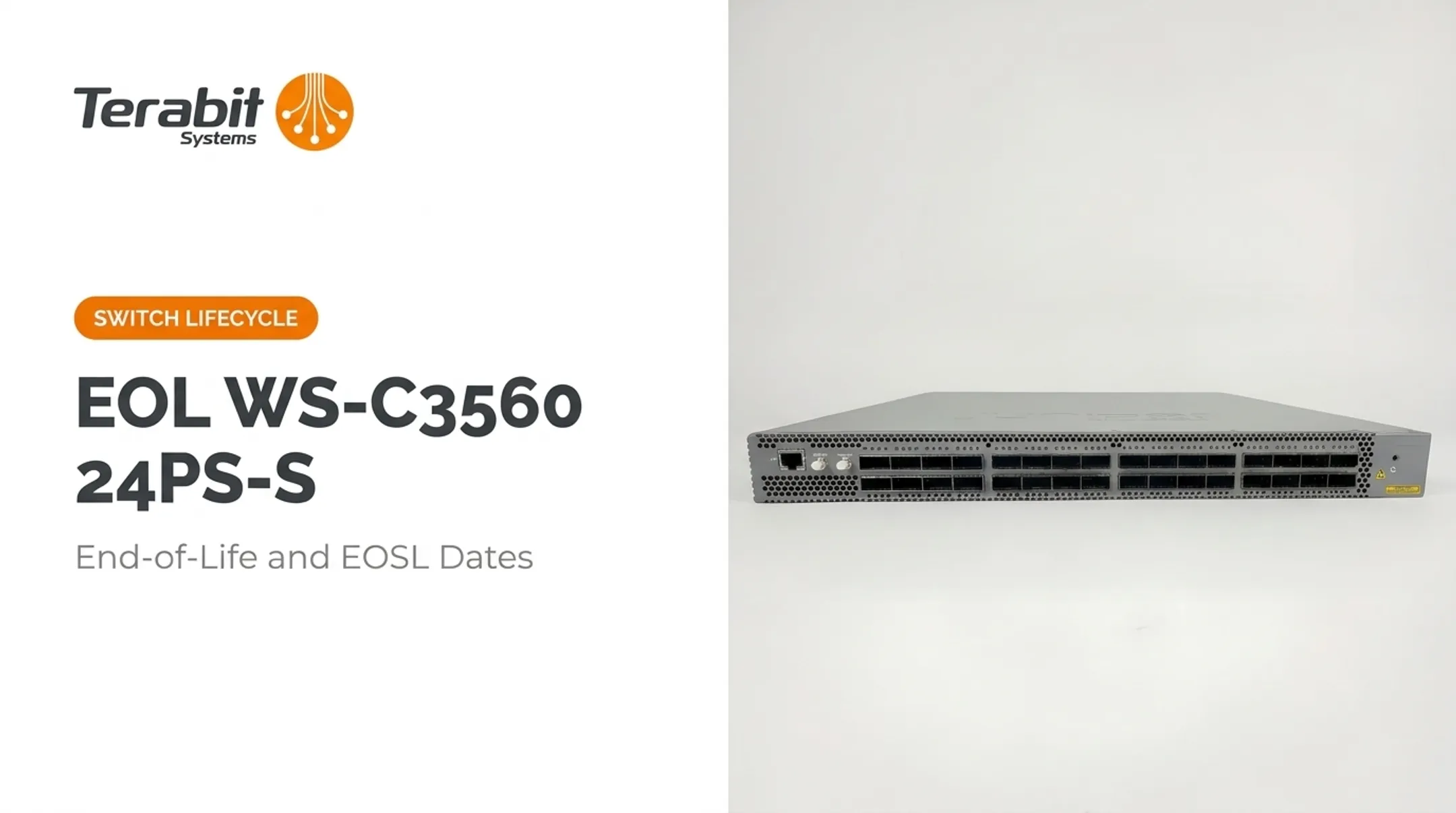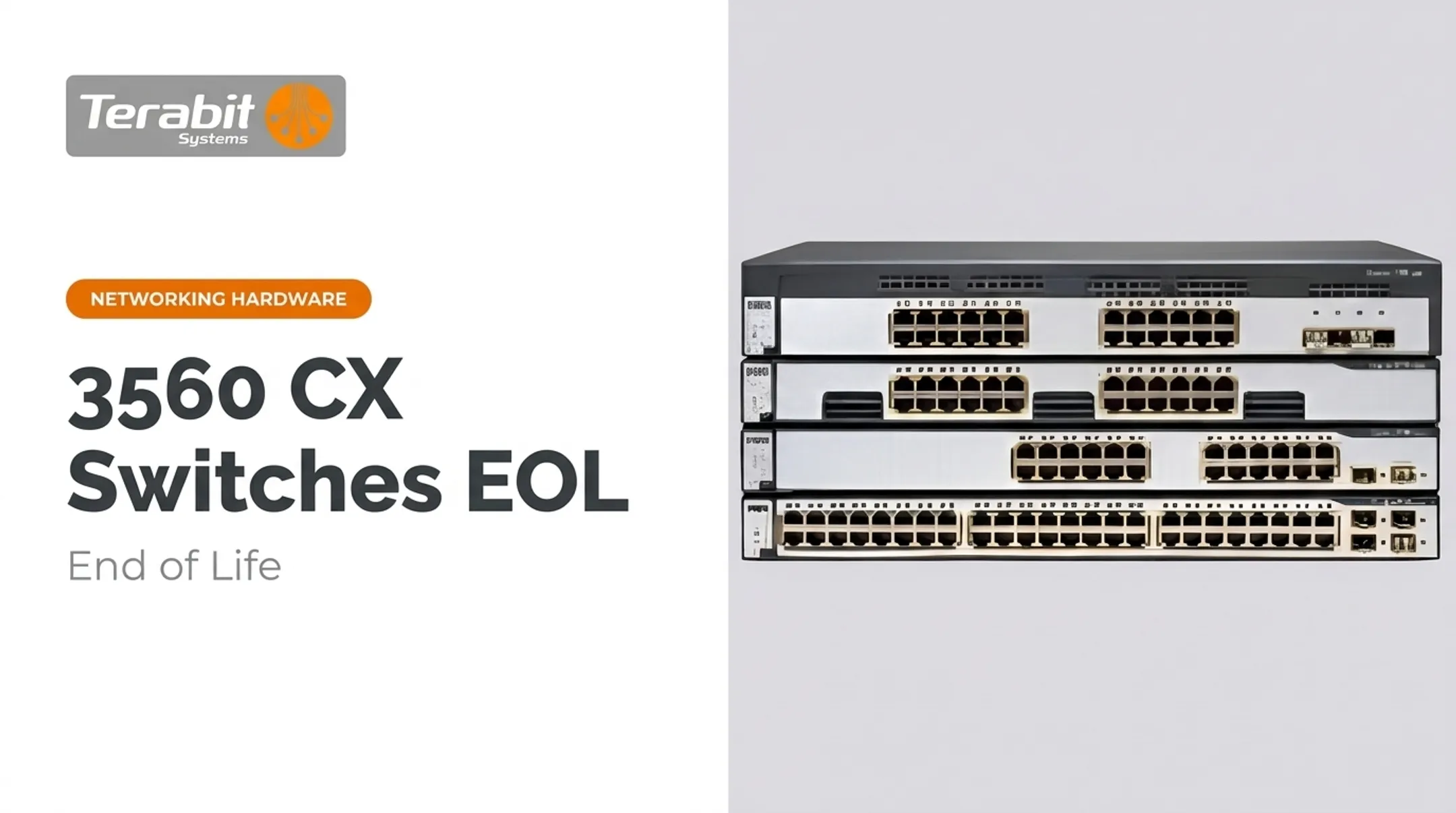

The Catalyst 3560-X series earned its reputation as a dependable access-layer workhorse in wiring closets and branch offices across the country. Its retirement isn't just a footnote in a Cisco bulletin — it forces real budget conversations and replacement timelines for the teams still relying on it.
This article walks through the full lifecycle timeline for this exact SKU, explains what EOL and EOSL status actually mean for support and security, and covers practical next steps, including refurbished hardware and asset recovery options.
Key Takeaways
- The WS-C3560X-24T-S passed End-of-Sale in 2016 and hit its Last Date of Support on October 31, 2021
- Post-LDOS, Cisco provides zero software fixes, security patches, or hardware replacements for this switch
- Refurbished units stay available, and migration paths like the Catalyst 9300 series offer a clear upgrade route
- Terabit Systems buys, sells, and manages ITAD disposition for the WS-C3560X-24T-S and related Catalyst hardware
WS-C3560X-24T-S End-of-Life (EOL) and EOSL Timeline
Cisco issued its official End-of-Sale and End-of-Life bulletin for the Catalyst 3560-X series on October 31, 2015. The WS-C3560X-24T-S appears in that bulletin's product table as "Catalyst 3560X 24 Port Data IP Base," and its milestones are locked in.
Cisco's Milestone Structure Explained
Cisco's standard EOL process runs through six checkpoints:
- End-of-Sale (EOS): last date to order the product through Cisco channels
- End of SW Maintenance Releases: no more software bug fixes or enhancements
- End of Routine Failure Analysis: no more root-cause investigation for failures
- End of Vulnerability/Security Support: no more security patches, period
- End of Service Contract Renewal: last date to renew or extend Cisco service coverage
- Last Date of Support (LDOS): the final date any support exists at all
Exact Dates for the WS-C3560X-24T-S
| Milestone | Date |
|---|---|
| End-of-Sale Date | October 30, 2016 |
| End of SW Maintenance Releases | October 30, 2017 |
| End of Routine Failure Analysis | October 30, 2017 |
| End of Vulnerability/Security Support | October 30, 2019 |
| End of Service Contract Renewal | January 28, 2021 |
| Last Date of Support (EOSL) | October 31, 2021 |

EOL vs. EOSL: EOL is Cisco's announcement that the retirement clock has started. EOSL (which Cisco technically labels LDOS) is the finish line — the date after which literally nothing is available, not TAC calls, not RMA hardware, not security patches.
Cisco's own support page for this series now states plainly: "This product is no longer Supported by Cisco." The bulletin's stated replacement for this exact SKU was the WS-C3650-24TD-S, though Cisco's current materials point newer buyers toward the Catalyst 9300 series for current access-layer deployments.
What EOL/EOSL Status Means for Your Network
Once a switch crosses its Last Date of Support, three things become permanently unavailable from Cisco:
- TAC support — no engineer picks up the phone for this hardware
- RMA replacements — a dead unit stays dead, no swap-out
- Firmware and security patches — any newly discovered vulnerability stays open forever
That last point is not theoretical. Research from VulnCheck, covered by Cybersecurity Dive in March 2026, found that 42.5% of exploited edge-device vulnerabilities in 2025 hit devices that were end-of-life or likely end-of-life.
Roughly two-thirds of vulnerabilities tied to botnet activity involved devices no longer receiving active vendor support.
That study covers network-edge devices broadly, not this specific switch model. But the pattern is clear: unsupported hardware is disproportionately where attackers focus.
There's also a compounding hardware-failure risk. Aging capacitors, fans, and power supplies fail more often the longer a unit runs. With no RMA path, a failure becomes a scramble.

None of this means every EOSL switch needs to come out of the rack tomorrow. Plenty of enterprises keep these units running in non-critical roles: a lab environment, a low-priority closet, or a segmented test VLAN. That's defensible only with a documented risk-acceptance plan and a spare or replacement path ready for when—not if—the hardware fails.
Should You Replace, Repair, or Keep Running the WS-C3560X-24T-S?
Once the WS-C3560X-24T-S hits EOSL, most teams choose one of three paths:
- Keep running — stay on the installed base with monitoring and shelf spares, accepting that Cisco TAC and software updates are gone
- Repair — use third-party maintenance or component repair when a unit fails, buying time without a full refresh
- Replace — move to certified refurbished 3560-X stock, or migrate to a current access platform such as the Catalyst 9300

For many SMBs, ISPs, and cost-conscious IT teams, certified refurbished replacement is the practical middle ground. It extends usable life at a fraction of new-hardware cost without forcing a full-platform migration on the vendor’s timeline.
Terabit Systems runs refurbished units through a five-step quality assurance process before resale:
- Physical inspection for connector, faceplate, and latch damage
- Functional testing — POST diagnostics, log review, port and module tests
- Factory reset with full config and password removal
- Cleaning and cosmetic refurbishment
- Final QC, kitting, and packing

That process, backed by warranty coverage, gives teams a tested switch and a clear next step when production hardware fails.
A practical safety net: keeping one or two spare units on a shelf, purchased used, is cheap insurance against a post-EOSL failure taking down a closet with no replacement path.
Before deciding, weigh total cost of ownership honestly:
- What does extending the current hardware actually save versus a full refresh?
- Does your industry's compliance framework require currently supported firmware?
- How critical is the switch's role — edge closet or core distribution?
What to Do With Decommissioned WS-C3560X-24T-S Units
Retiring a switch is both a technical and a data-security decision. Before any unit leaves the building, wipe configurations and remove stored credentials.
From there, don't default to scrapping the hardware. Decommissioned switches, even EOSL ones, often retain resale value. Selling through an ITAD or asset-recovery partner turns dead-weight inventory into recovered capital instead of a disposal cost.
Terabit Systems' buy-back process works like this:
- Call to set up a free audit of surplus gear
- Terabit evaluates the equipment and offers either fair-market value or trade-in credit toward networking hardware
- Terabit's ITAD service handles end-of-use disposition so surplus racks don't sit depreciating
For companies sitting on stacks of decommissioned 3560-X units, that's often a faster path to recovered budget than trying to sell hardware piecemeal on the open market.
Frequently Asked Questions
Is the Cisco WS-C3560X-24T-S end of life?
Yes. Cisco's official EOL bulletin set the End-of-Sale date at October 30, 2016, and the Last Date of Support closed on October 31, 2021. The switch is fully past every lifecycle milestone Cisco publishes.
What is the difference between EOL and EOSL for Cisco switches?
EOL marks the start of the retirement process: Cisco announces the product will eventually lose support. EOSL (or LDOS) is the final milestone, after which no support of any kind remains available.
Can I still buy the WS-C3560X-24T-S after it's discontinued?
Cisco no longer sells this switch new. Refurbished units do circulate through specialized resellers like Terabit Systems, though availability and condition vary and are best confirmed directly with a specialist.
What is the recommended replacement for the WS-C3560X-24T-S?
Cisco's original bulletin named the WS-C3650-24TD-S as the direct replacement. Current Cisco guidance points toward the Catalyst 9300 series as the modern access-layer path. Refurbished 3560-X or 3650 units remain a budget-friendly interim option.
Is it safe to keep using an EOSL switch in production?
It carries risk — no security patches, no RMA support, and rising failure odds as hardware ages. Many teams keep EOSL switches running in non-critical roles, but only with a documented risk-acceptance plan.
How can I sell my old Cisco networking equipment?
Terabit Systems offers free audits of surplus gear and pays fair-market value or trade-in credit for decommissioned equipment, helping you recover capital instead of scrapping it.