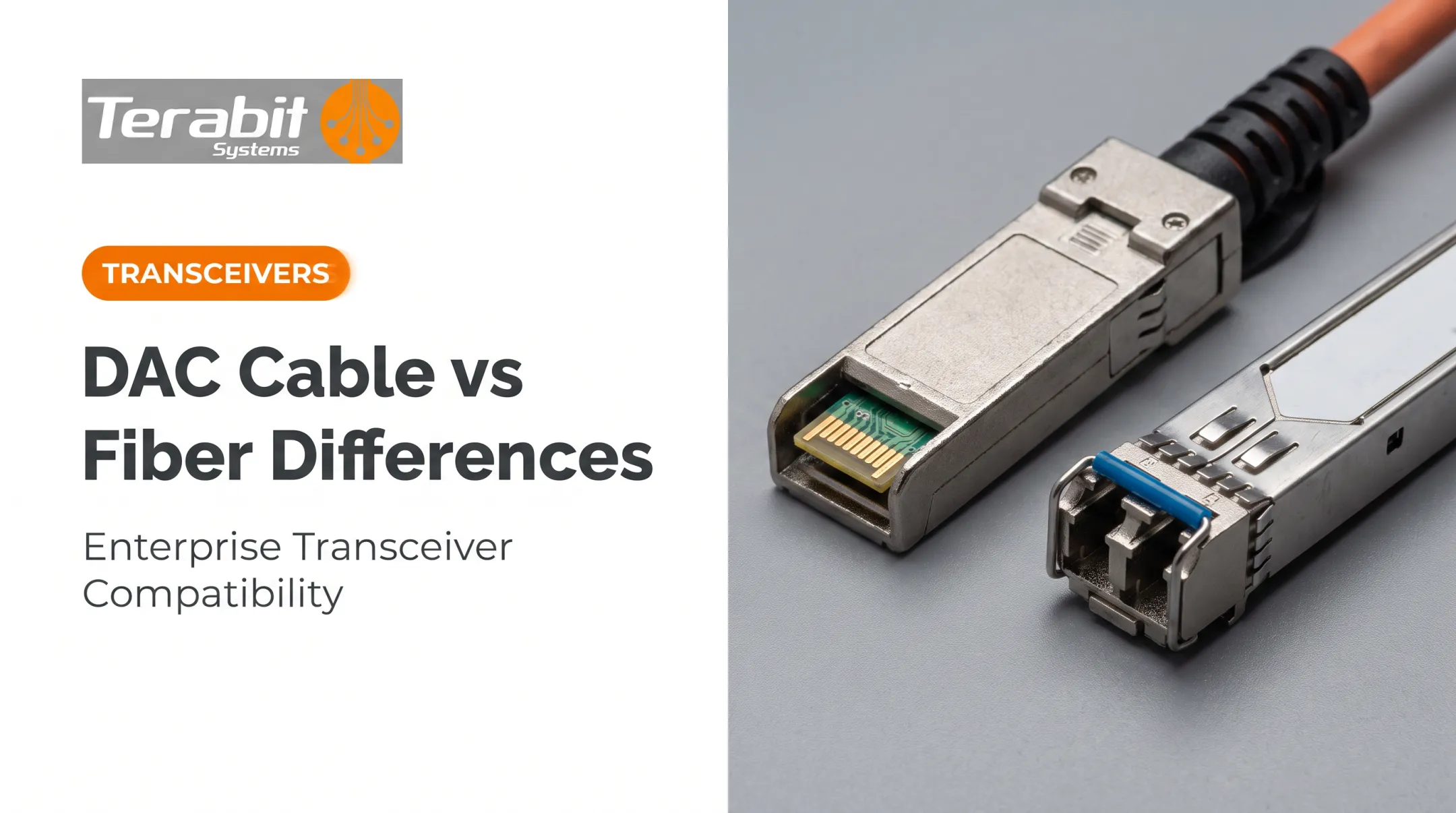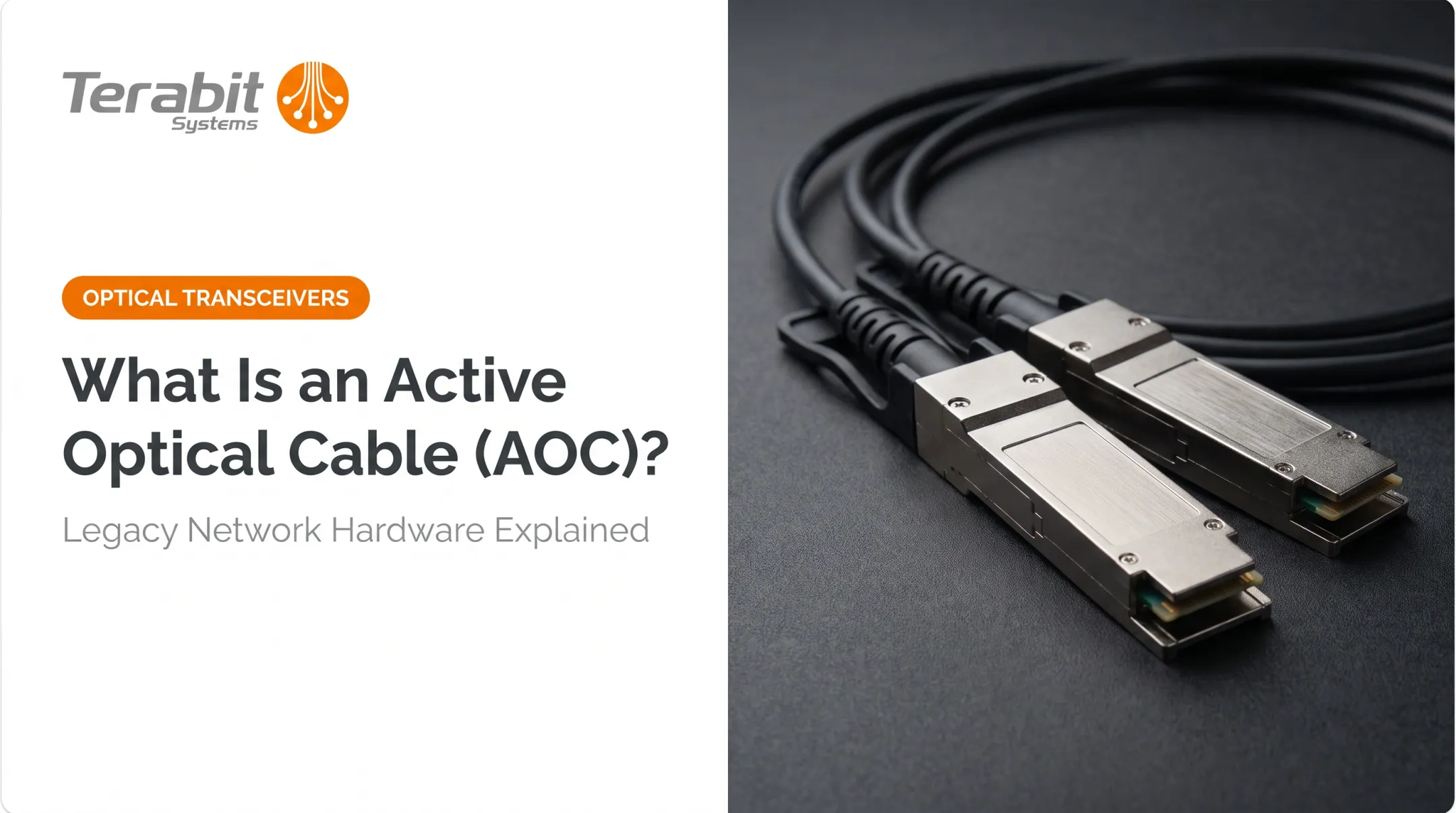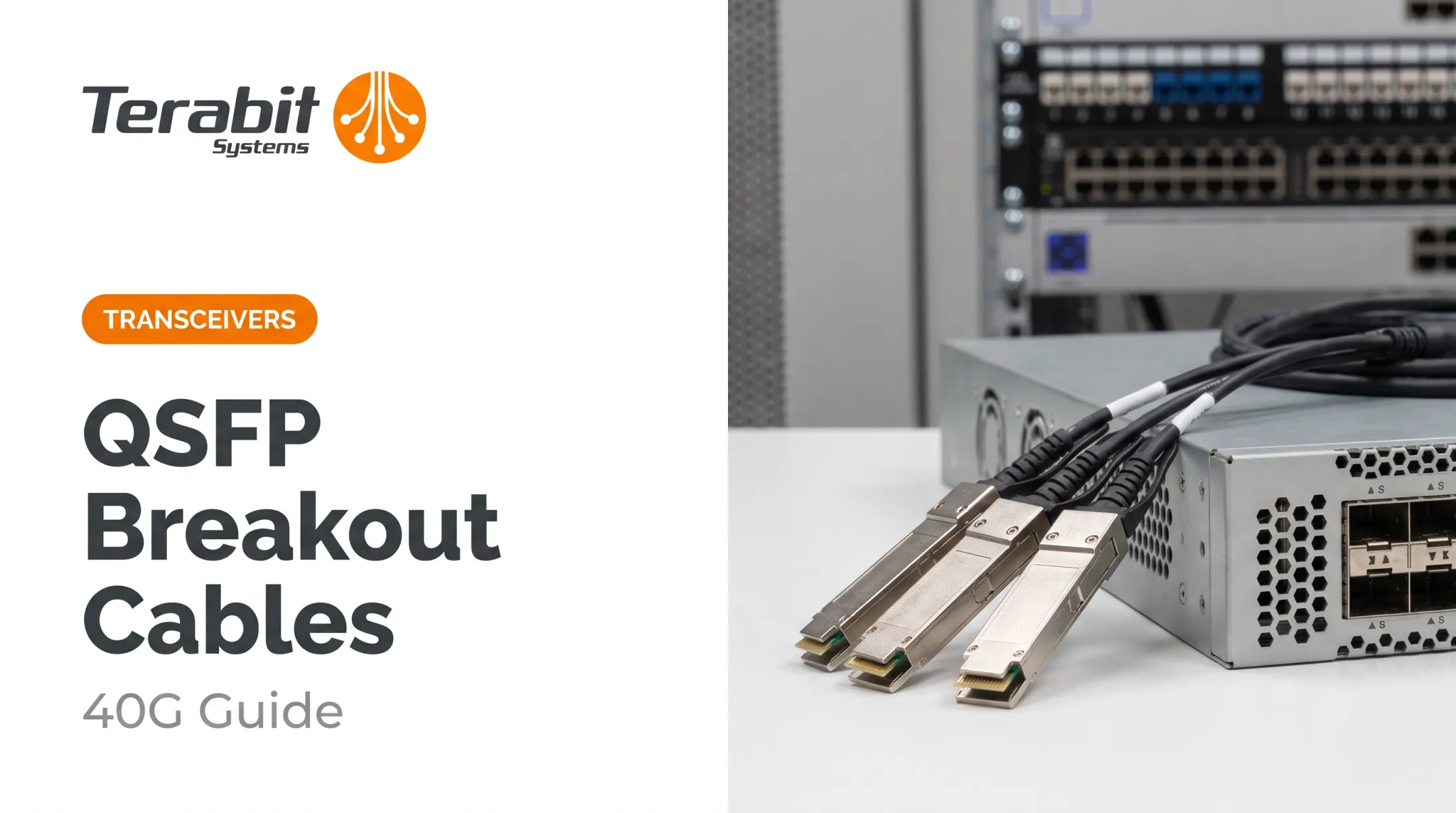

Pick wrong and you'll either overspend on unnecessary optics or hit distance limits that force a costly rework. This guide breaks down the technical differences, real use cases, and how to choose based on your specific rack layout and budget.
TL;DR
- Copper vs fiber: DAC (Twinax) for short, low-cost, low-latency links; AOC (optics) for longer reach and EMI immunity
- Placement: DAC for in-rack/ToR; AOC for inter-rack or End-of-Rack (EoR) runs
- Speeds: Both support up to 800G in SFP+, QSFP28, and QSFP-DD form factors
- Decision drivers: Distance, budget, power draw, and EMI exposure
- Cost lever: Refurbished DAC cables and compatible switches can cut buildout spend without new-equipment pricing
DAC vs AOC: Quick Comparison
Reach and power numbers vary by SKU, speed, and manufacturer. Here's how the two categories generally stack up, based on published vendor data sheets:
| Factor | DAC | AOC |
|---|---|---|
| Cost | Lower upfront cost; most economical for short links | Higher per-unit cost, but can beat separate transceivers + fiber on total spend |
| Composition | Twinax copper with integrated connectors | Multimode fiber (OM3/OM4) with permanently attached optics |
| Distance | Commonly 0.5m–7m passive; active variants stretch to 10m | Commonly up to 30m; some SKUs rated to 100m |
| Power | Passive: under 0.15W typical; active: roughly 0.5–1.0W | Roughly 0.8W–2.2W depending on speed; higher for 800G modules |
| EMI resistance | Susceptible to electromagnetic interference | Fiber is electrically isolated, so EMI is not a practical concern |

Important caveat: These are product-family generalizations, not fixed standards. Cisco's 40G passive copper tops out around 2–5m, while its active copper reaches 7–10m. Arista's 800G twinax, by contrast, only runs 1–2m at that speed.
Always check the actual data sheet before ordering.
What Is DAC?
Direct Attach Copper is a factory-terminated Twinax cable assembly with connectors built directly onto each end, so no separate transceivers are required. It plugs straight into switch and server ports for short-reach, rack-level connections.
Core benefits:
- Near-zero latency (no optical conversion)
- Minimal power draw, especially passive variants
- Plug-and-play simplicity with no separate optics to source or match
- Lowest cost per link for short distances
Two variants cover most rack needs:
- Passive DAC: No signal-conditioning electronics in the connector, so power draw stays minimal and reach stays short
- Active DAC: Onboard circuitry boosts signal integrity and extends reach to around 10m on many 40G products, with a small power increase

Use Cases of DAC
DAC dominates ToR switch-to-server and switch-to-storage connections, where the run length rarely exceeds a few meters. Common buyers include:
- Cost-conscious cloud and hosting providers building dense server racks
- ISPs standardizing on predictable, same-rack cabling paths
- Switch stacking configurations within a single cabinet
Terabit Systems supplies tested, refurbished DAC-compatible switching hardware from Arista, Juniper, and Cisco for teams cutting rack networking costs without giving up reliability.
The company also stocks Juniper direct-attach Twinax cables (EX-SFP-10GE-DAC series, 1m through 7m) and Cisco QSFP-H40G-CU5M 40G copper cables as standalone products.
What Is AOC?
An active optical cable (AOC) embeds optical transceivers and electronics inside a sealed cable assembly. From the outside it looks like a standard pluggable cable; internally, it converts electrical signals to light and back at each end. That design makes AOC the practical choice once copper's reach or bend limits become a problem.
Core benefits:
- Longer reach: many SKUs run to 30m, some to 100m
- Lighter, more flexible cabling than Twinax
- Reduced susceptibility to electrical coupling in congested cable trays
- Available across SFP+, SFP28, QSFP28, QSFP-DD, and OSFP form factors, supporting speeds up to 800G
Because the optics are sealed inside the connector, AOC skips the compatibility headaches of pairing separate transceivers with patch fiber. That simplicity comes at a price: expect higher per-unit power draw and cost than passive DAC.

Use Cases of AOC
AOC shines in End of Rack (EoR) switch connections and links spanning multiple racks or rows, where copper's reach simply runs out. It's also preferred in:
- EMI-heavy environments near power infrastructure or high-voltage equipment
- Facilities with tight, congested cable trays where flexible fiber routing matters
- 800G deployments where copper's reach compresses to 1-2m
LightCounting's market forecast projects a 14% CAGR for AOCs and 25% for copper cables between 2023 and 2027, with roughly 10 million AOCs shipped annually by 2027 compared to 20 million copper cables.
The same research notes that most high-speed cable volume goes into HPC and AI clusters rather than general enterprise racks. That signal is useful, though it does not break out hyperscale versus Tier-2 adoption specifically.
DAC vs AOC: What's Better for Your Data Center?
There's no universal winner. The right call depends on four factors:
- Distance — Can your longest run stay under 7-10m? DAC works. Beyond that, AOC becomes necessary.
- Budget — DAC wins on raw unit cost for short links; AOC can still beat buying separate transceivers plus fiber patching for longer runs.
- Power and cooling — Passive DAC draws almost nothing. AOC's optics add measurable power load per port, which matters at scale.
- Rack density and EMI — Dense racks with tight bends favor AOC's flexibility; EMI-heavy zones favor AOC's isolation.

Situational recommendation:
- Choose DAC for short, high-density, cost-sensitive rack connections
- Choose AOC when spanning longer distances, routing around tight bends, or facing EMI concerns
- Run a hybrid setup when both apply: DAC for server-to-ToR inside the rack, AOC between racks or rows for EoR and spine links
Most data centers already mix the two. Match each cable type to the job it does best.
Making Smart Cabling Decisions on a Budget
Cabling is only part of the spend. The switches, routers, and transceivers driving these links represent the bigger capital expense, and that's where real savings show up. Tier-2 cloud providers, regional ISPs, and VARs regularly stretch budgets further by sourcing certified refurbished networking hardware instead of buying new. Terabit Systems backs its refurbished Arista, Juniper, Cisco, and Extreme gear with a one-year replacement or refund warranty. Every unit goes through a five-step process: physical inspection, functional and traffic testing, factory reset, cosmetic refurbishment, and final QC. A few practical ways to extend your cabling budget:
- Buy refurbished switches and DAC cables together to cut per-port costs on ToR builds
- Ask about quote-based volume pricing — Terabit offers a 10% discount on qualifying 10+ unit orders
- Trade in surplus switching gear when you upgrade; Terabit's free audit evaluates equipment for fair-market value or trade-in credit Pair the right cabling choice with refurbished hardware sourcing, and smaller operators can match larger competitors on infrastructure spend without overspending on new gear.
Conclusion
The right choice between DAC and AOC depends on distance, budget, and the environment of each network segment. DAC cuts power draw and CAPEX in dense, short-reach setups. AOC covers flexible, long-reach, EMI-resistant links where copper cannot go.
Pair those cable decisions with refurbished switches, routers, and optics from a reseller like Terabit Systems when you want lower CAPEX without giving up tested hardware and warranty coverage.
Frequently Asked Questions
What is the difference between DAC and AOC?
DAC uses copper for short, low-cost, low-power links, while AOC uses fiber optics for longer reach and EMI resistance. Both support similar data rates in comparable form factors.
What are AOC cables used for?
AOCs handle end-of-rack (EoR) switch connections, longer inter-rack links, and EMI-prone environments where copper cabling falls short on distance or signal integrity.
What do DAC and AOC stand for?
DAC stands for Direct Attach Copper, reflecting its Twinax copper construction. AOC stands for Active Optical Cable, reflecting its embedded optical transceivers.
Is AOC (fiber) better than DAC?
Neither is strictly better. AOC excels at longer distances and EMI resistance, while DAC wins on cost and power efficiency for short runs.
How far can DAC cables run compared to AOC?
DAC typically maxes out around 7–10 m for most speeds. AOC commonly reaches 30 m and up to 100 m on some SKUs, though thinner fiber jackets mean careful handling on longer runs.
Do DAC and AOC cables work with the same switches?
Generally yes, provided the switch port supports the specific form factor, speed, and cable type. Always verify compatibility against the switch's data sheet before ordering.