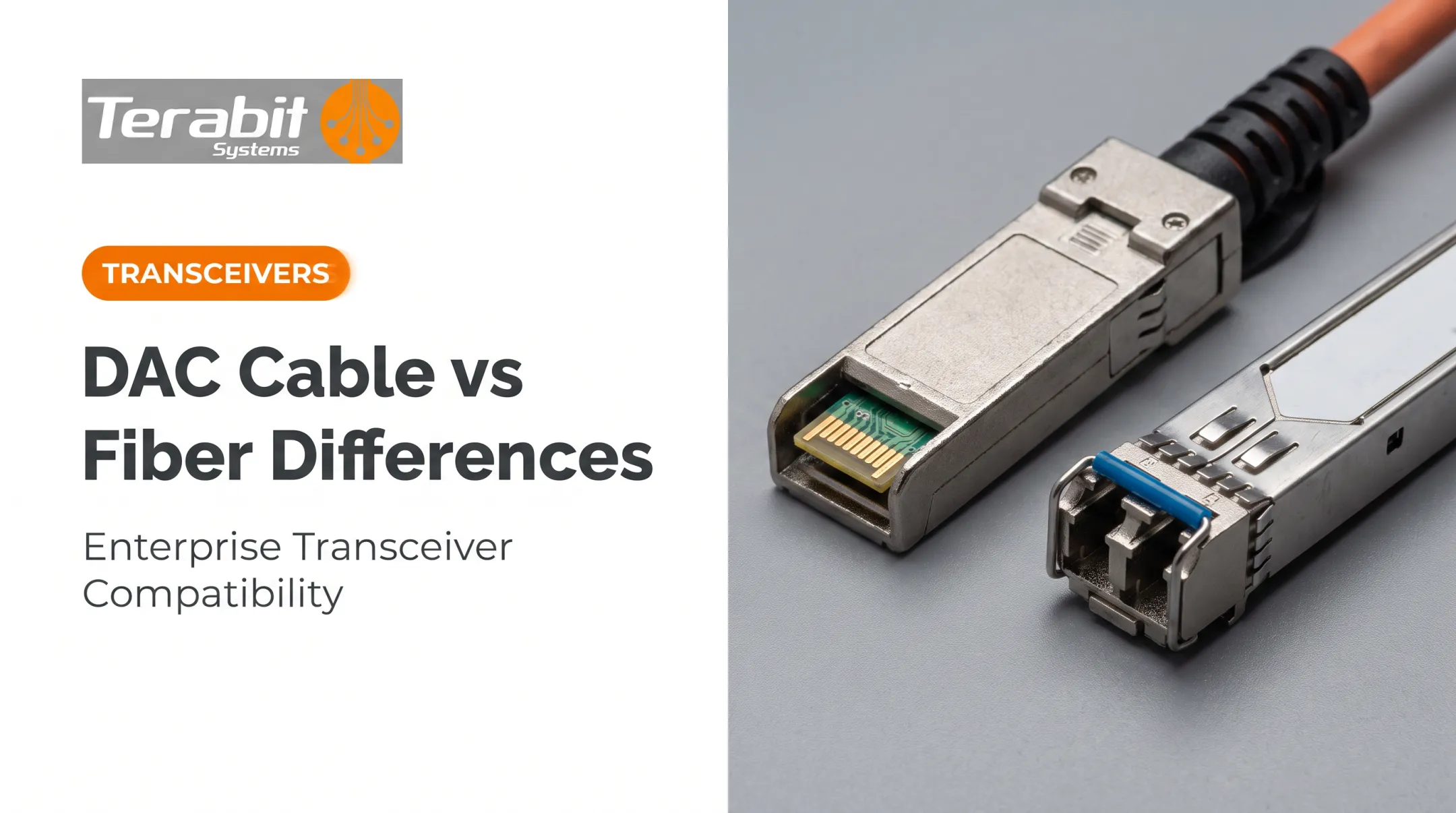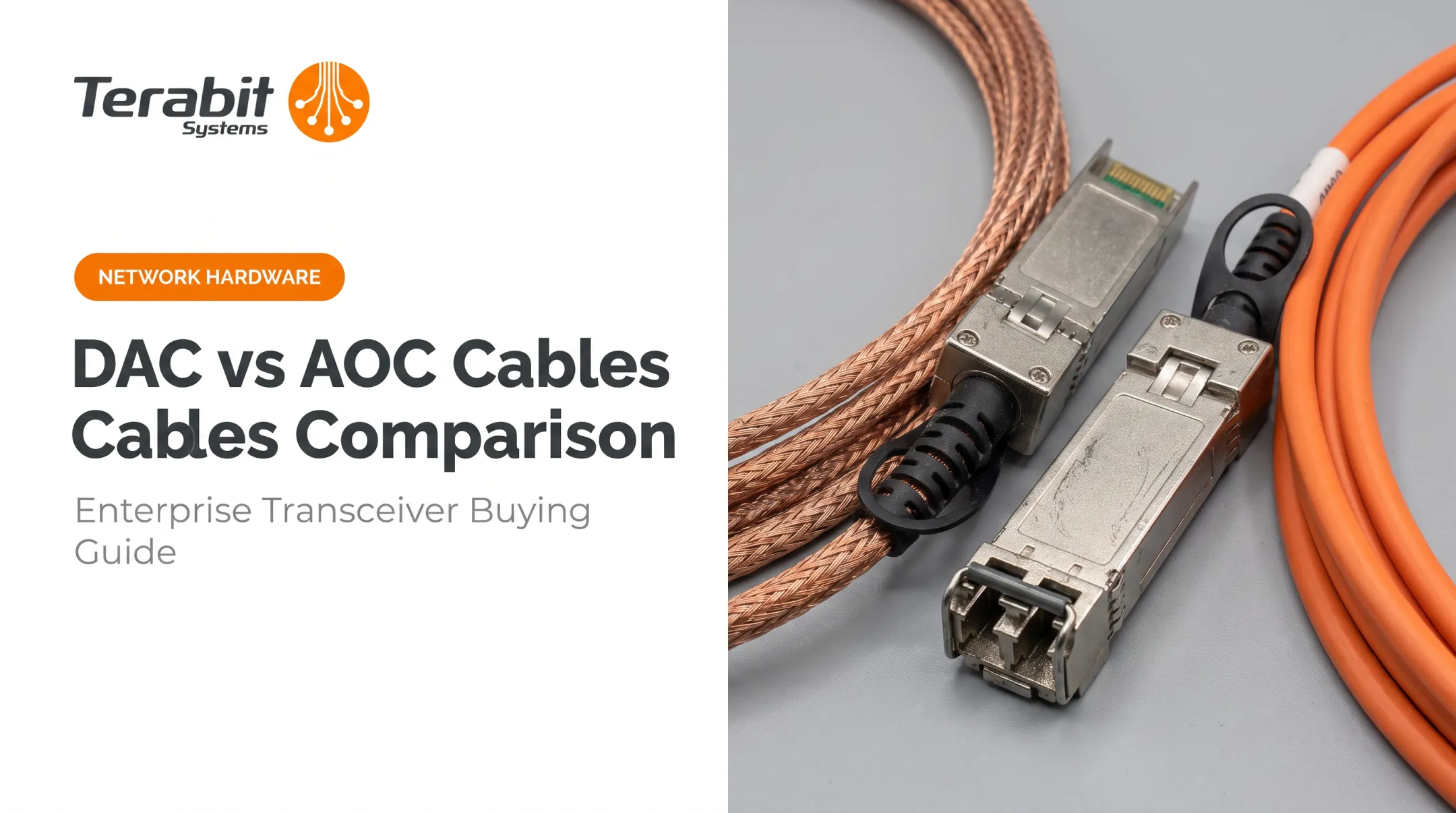

Many buyers confuse DAC with AOC, fiber, or even RJ45 copper cabling. That mix-up leads to compatibility headaches and wasted budget on the wrong gear.
This guide breaks down what DAC cables actually are, how active and passive versions differ, which speeds and lengths work where, and how to buy smart—including where refurbished options fit in.
Key Takeaways
- DAC cables pair twinax copper with fixed connectors for short-reach, high-speed links
- Passive DACs cost less on short runs; active DACs cost more and extend reach
- Speed and length limits follow each OEM portfolio—not one universal standard
- Refurbished DAC cables and switches cut infrastructure cost without giving up reliability
What Is a Direct Attach Copper (DAC) Cable?
A DAC cable is a pre-terminated twinax copper assembly with connectors—SFP+, QSFP+, QSFP28, and similar form factors—molded onto each end. Plug one end into a switch port, the other into a server or storage device, and you have a link. No separate transceiver required.
Juniper defines DAC cables as twinax copper assemblies that transmit electrical signals directly between devices. That direct path cuts the extra cost and complexity of standalone optical modules (Juniper's cable types documentation).
Are DAC cables copper or fiber? Copper. Full stop. That's the defining trait separating DAC from AOC (Active Optical Cable) or fiber patch cables, which use optical signaling instead of electrical.
Where DAC Cables Actually Get Used
- Top-of-rack switching — connecting switches to servers within the same rack
- Server-to-switch links — the most common enterprise deployment
- Storage interconnects — linking SANs or storage arrays to network fabric
- Switch-to-switch — adjacent rack connections where distance stays short
Breakout DAC Cables Worth Knowing
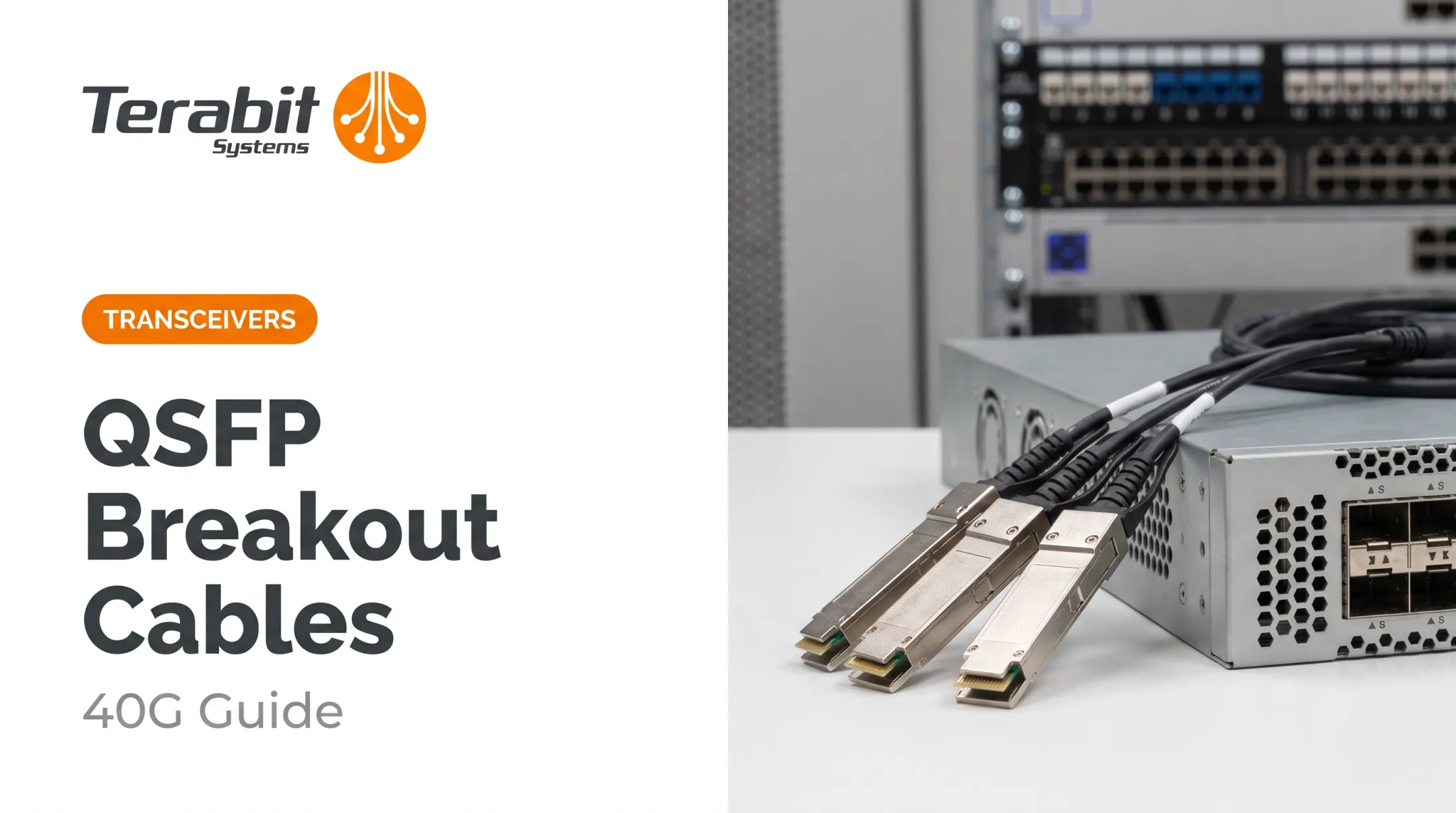
Some DAC cables split one high-speed port into multiple lower-speed connections. Common breakout configurations include:
- 40G QSFP to 4x SFP+ — one 40G port becomes four 10G links
- 400G QSFP-DD — splits into four 100G (QSFP56) or two 200G connections
These help when your switch has fewer high-density ports than you need endpoints.
Active vs. Passive DAC Cables: Which Do You Need?
This is the single most important decision when specifying a DAC cable. Get it wrong, and you'll either overpay or run into signal issues.
Passive DACs contain no electronics to boost the signal. They're simpler, cheaper, and draw almost no power. Juniper notes passive DACs typically max out around 7 meters. Cisco's 10G passive Twinax lineup (1 m through 5 m) lists a maximum power draw of just 0.1 watts.
Active DACs include a signal-conditioning chip that compensates for cable loss, letting them run longer. Juniper describes active DACs as capable of extending to 10 meters or more. Cisco's active 10G models (7 m and 10 m) list a maximum power draw of 1 watt—roughly 10x the passive figure.
That's a meaningful power difference at scale. A rack with 48 active links draws noticeably more power than the same rack wired with passive cables, even if the per-cable number sounds small.
Choosing Between Them
| Factor | Passive DAC | Active DAC |
|---|---|---|
| Typical max reach | Up to 7 m | 10 m or more |
| Power draw (10G example) | 0.1 W max | 1 W max |
| Cost | Lower | Higher |
| Best for | In-rack, short runs | Adjacent racks, longer runs |

Quick decision rule: If your run stays inside one rack, go passive. If you're bridging to a neighboring rack or need extra headroom, active earns its higher price tag.
DAC Cable Speeds, Lengths, and Compatibility
A 10G DAC cable is an SFP+ based twinax assembly supporting 10 Gigabit Ethernet. Cisco's 10G SFP+ Twinax lineup cites IEEE 802.3 Ethernet compliance along with SFF-8431 (passive) and SFF-8461 (active) standards.
Common Speed and Form-Factor Pairings
- SFP+ to SFP+ — 10G, the most widely deployed DAC type
- QSFP+ to QSFP+ — 40G switch-to-switch links
- QSFP28 to QSFP28 — 100G, common in modern data center spines
- QSFP-DD to QSFP-DD — 400G, current high-density deployments
Maximum Recommended Lengths
Length limits shrink as speed climbs, because signal integrity gets harder to maintain over copper at higher frequencies. OEM product sheets show:
- 10G passive: up to 5 m (Cisco lineup); active extends to 10 m
- 40G passive: up to 5 m (Arista); active options to 10 m
- 100G passive: up to 5 m (Arista/FS.com)
- 400G passive: up to 3 m (Cisco QSFP-DD lineup)
Notice the trend: 400G passive DACs top out at roughly half the length of their 10G counterparts. Higher-frequency signals degrade faster over copper, so manufacturers cap length to preserve reliability.

If your rack layout needs longer 100G or 400G runs, active DAC or fiber is the better fit. Port generation also matters when you mix gear across refresh cycles.
Compatibility Across Generations
- QSFP-DD ports accept QSFP+, QSFP28, and QSFP56 modules and cables (per Cisco guidance)
- Same-form-factor DACs (SFP+↔SFP+, QSFP28↔QSFP28) remain the default for matched switch pairs
- Breakout DACs (for example QSFP28 to 4× SFP28) fan one high-speed port into multiple lower-speed links
- MSA-compliant assemblies interoperate across major OEMs when both ends support the same speed and coding
DAC vs. SFP Transceivers and Fiber: Making the Right Choice
What is the difference between SFP and DAC cables? SFP refers to a port and transceiver form factor—a slot that accepts pluggable optical or copper modules. DAC is a complete cable assembly with the connectors permanently attached to each end. You don't insert a separate transceiver into a DAC cable; the "transceiver" function is built into the connector itself.
DAC vs. Fiber/AOC: The Real Tradeoffs
| Factor | DAC (Copper) | Fiber/AOC |
|---|---|---|
| Cost | Lower per link | Higher per link |
| Power draw | Near-zero (passive) to low (active) | Low to moderate (optical engines in the connectors) |
| Max reach | 3-10 m typical | Hundreds of meters (SFP-10G-SR reaches 300-400 m) |
| Durability | More resistant to dust and physical wear | More fragile, sensitive to bend radius |
| Weight/flexibility | Heavier, stiffer | Lighter, easier cable management |
Juniper describes DAC as more durable and less susceptible to dust than optical fiber, while AOC offers lighter weight and immunity to electromagnetic interference. Cisco notes the same tradeoff, calling out AOC's airflow and EMI advantages for high-density cabling runs.

When fiber wins:
- Longer runs between racks or rows
- Dense cable trays where weight and bend radius matter
- Environments with heavy EMI
When DAC wins:
- Short in-rack or adjacent-rack connections
- Links where cost and simplicity matter more than distance
Buying DAC Cables and Networking Gear the Smart Way
Before ordering, nail down three things:
- Vendor compatibility. DAC cables are often coded to a specific switch vendor's firmware. Mixing brands without checking compatibility risks link failures.
- Speed requirements. Match the cable to your port's actual speed (10G, 40G, 100G, 400G), not just its physical form factor.
- Length planning. Measure your actual rack distance, then add margin. Ordering slightly long is cheaper than re-ordering.
Where Refurbished Fits In
New DAC cables and switches aren't cheap, and for many IT teams, buying everything new isn't realistic on a tight budget. Sourcing certified refurbished networking hardware alongside new equipment can cut costs significantly while still meeting production standards. Based in San Francisco, Terabit Systems supplies rigorously tested, warrantied refurbished networking gear, including DAC cables, switches, and transceivers from Arista, Juniper, Cisco, and Brocade. Every unit goes through a multi-step quality process before it ships:
- Physical inspection and functional testing
- Cosmetic refurbishment and final QC
- Backed by a 1-year replacement or refund guarantee on qualifying offline orders Terabit stocks catalog items such as the Juniper EX-SFP-10GE-DAC series (1m, 3m, 5m, 7m SFP+ options) and Brocade's 40G-QSFP-C-0101 QSFP direct-attach cable, with quote-based bulk pricing on orders of 10+ units. Decommissioning old gear? Terabit's asset recovery program lets businesses sell surplus networking equipment back for fair market value or trade-in credit, turning idle hardware into budget for the next upgrade.

Frequently Asked Questions
What is a DAC cable?
A DAC cable is a twinax copper cable assembly with integrated connectors on each end, built for short-range, high-speed connections between switches, servers, and storage devices. It eliminates the need for separate transceivers.
Are DAC cables copper or fiber?
DAC cables use copper twinax construction to carry electrical signals, distinct from fiber-based AOC or optical cables, which transmit light. This copper build is what keeps DAC cost and power consumption low.
What is the difference between active and passive direct attach cables?
Passive DACs have no signal-boosting electronics, cost less, and typically reach 5–7 meters. Active DACs include a conditioning chip, cost more, draw more power, and reach about 10 meters.
What is the maximum recommended length for SFP+ DAC cable?
Passive SFP+ DAC cables generally max out around 5–7 meters, while active versions extend to about 10 meters. Exact limits vary by manufacturer and cable generation.
What is the difference between SFP and DAC cables?
SFP is a port and transceiver form factor that accepts pluggable modules. DAC is a complete fixed cable assembly with connectors built in, so there's no separate transceiver to install.
What is a 10G direct attach cable?
A 10G DAC cable is an SFP+-based twinax copper cable supporting 10 Gigabit Ethernet links, commonly used for server-to-switch and switch-to-switch connections within a rack.