
A BiDi (Bi-Directional) transceiver sends and receives on a single fiber strand using two different wavelengths, instead of requiring separate strands for transmit and receive. This guide breaks down how they work, where they fit, and how to choose the right one.
For budget-conscious teams, buying compatible or refurbished BiDi optics through resellers like Terabit Systems can trim costs further than sourcing new OEM units — though as we'll cover, pricing and stock vary, so always confirm specs before you order.
Key Takeaways
- BiDi transceivers use WDM diplexer technology to transmit and receive on one fiber strand
- Deploy in matched pairs with opposite Tx/Rx wavelengths (an "A" unit and a "B" unit)
- Single-fiber operation can cut strand usage roughly in half compared to duplex transceivers
- Form factors include SFP, SFP+, QSFP+, and QSFP28, spanning 1G to 100G speeds
- Refurbished and compatible BiDi modules from resellers can lower acquisition costs versus new OEM pricing
What Is a BiDi Transceiver?
A BiDi transceiver is an optical module that transmits and receives signals over a single fiber strand by using two different wavelengths and an internal WDM diplexer to separate the paths. Standard duplex transceivers, by contrast, use two separate fibers: one for sending, one for receiving.
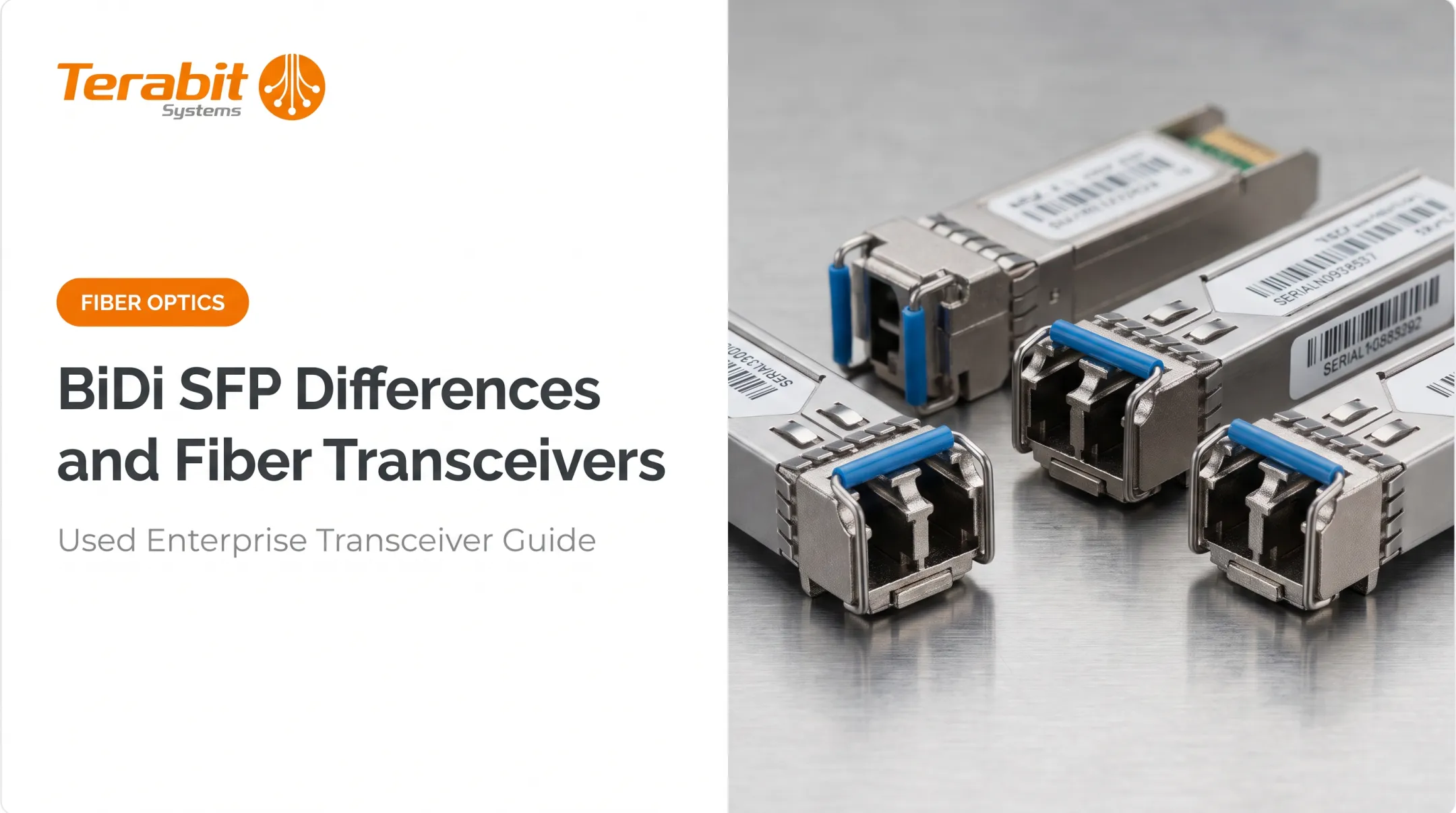
The physical giveaway is the connector. Duplex modules use a dual LC connector with two fiber ports. Most BiDi SFP and SFP+ modules use a single LC or SC connector, since only one strand is involved.
You'll typically find BiDi optics deployed in:
- Data centers with limited spare fiber strands
- Metro networks connecting buildings or POPs
- FTTx and RRU (remote radio unit) links, especially during mobile network upgrades
- Enterprise sites where existing conduit can't accommodate more cabling
Is BiDi Single-Mode or Multimode?
Most BiDi transceivers, particularly SFP and SFP+ models, use single-mode fiber (SMF), supporting reaches from 10 km to over 40 km depending on the wavelength pair. Cisco's 1000BASE-BX SFP, for example, runs on one SMF strand for up to 10 km using a single LC/PC connector.
Higher-speed variants tell a different story. Cisco's QSFP-40G-SR-BD module uses multimode fiber (OM3/OM4), delivering 100 meters on OM3 and 150 meters on OM4, but it uses a duplex LC connector with two bidirectional channels, not a single strand end-to-end. Don't assume every product labeled "BiDi" is strictly single-fiber; check the datasheet.
How BiDi Transceivers Work
WDM and the Diplexer
BiDi transceivers rely on Wavelength Division Multiplexing (WDM). Instead of two fibers carrying one signal each, one fiber carries two signals riding on different wavelengths of light. An internal diplexer (an optical filter) separates the incoming and outgoing signals so they don't interfere with each other on the shared strand.
The Matched-Pair Rule
BiDi optics only work in complementary pairs. One end transmits on wavelength A and receives on wavelength B; the other end does the opposite. A common example:
- End A: TX 1310nm / RX 1490nm
- End B: TX 1490nm / RX 1310nm
If you mismatch them, the link won't come up. This is the single most common installation mistake with BiDi optics: ordering two identical units instead of a complementary pair.
Inside the BOSA
The core component is the BOSA (Bi-Directional Optical Subassembly), which packs several parts into one small unit:

- A laser diode (transmitter)
- A photodetector (receiver)
- An optical lens for focusing the beam
- A WDM diplexer to split the two wavelengths
Wavelength pairing follows distance tiers. Short and medium-reach links commonly use 1310nm/1490nm pairs, while long-haul links shift to 1490nm/1550nm combinations for better performance over distance.
Higher-speed BiDi optics like 40G QSFP+ modules are different: they don't use a single simplex port. They use duplex LC connectors with two bidirectional channels, unlike the classic single-strand SFP design.
BiDi vs. Standard Duplex Transceivers: Key Differences
BiDi and standard duplex optics move the same traffic, but they trade fiber count for pairing discipline. The matrix below shows where that tradeoff shows up in day-to-day buys.
| Feature | Standard Duplex | BiDi |
|---|---|---|
| Connector | Dual LC (two ports) | Single LC/SC (one port), except high-speed variants |
| Fiber strands required | Two | One |
| Compatibility | Interchangeable at both ends | Requires matched A/B pair |
| Typical cost | Lower per-unit price | Slightly higher per-unit, offset by fiber savings |
| Best fit | Plentiful fiber plant | Strand-constrained sites |
The deployment logic differs too. Duplex transceivers are interchangeable — order the same part number for both ends of a link.
BiDi requires you to track which end gets the "U" (upstream) unit and which gets the "D" (downstream) unit. Get this wrong during a bulk rollout and you'll spend a frustrating afternoon swapping modules.

Why Use BiDi Transceivers? Business & Technical Benefits
Fiber Infrastructure Savings
By using one strand instead of two, BiDi optics free up existing fiber pairs for other links. RAD describes this as enhancing fiber efficiency by roughly 50%. That figure is about fiber resources, not a guaranteed dollar-for-dollar cost cut. Still, fewer strands used per link means:
- Fewer patch panel ports consumed
- Less cable tray congestion
- More headroom before you need to trench new fiber
Capacity Doubling on Existing Plant
Where you once ran one duplex link per fiber pair, BiDi lets that same pair support two independent bidirectional links. For metro carriers and data centers running out of spare strands, this effectively doubles usable capacity without touching the outside plant.
Fewer Points of Failure
Single-strand links mean fewer physical connections to maintain, patch, and troubleshoot. Fewer connectors also means fewer places for dirt, misalignment, or bad splices to cause problems.

Faster Upgrades
Swapping transceivers is far quicker than re-cabling. This matters most in scenarios like RRU and cell-site backhaul upgrades (for example 4G-to-5G), where operators need to boost radio backhaul capacity without dispatching crews to re-run fiber at every cell site.
Where Budget Matters Most
New OEM optics carry a premium, and that premium adds up fast across a large deployment. Terabit Systems supplies compatible and refurbished BiDi transceivers for Cisco, Juniper, and Brocade platforms, backed by testing and warranty coverage. This gives Tier-2 ISPs and budget-conscious enterprises a way to deploy single-fiber technology without paying full OEM list price on every port.
Types of BiDi Transceivers and Choosing the Right One
BiDi modules span several form factors and speeds, but they share one idea: send and receive on a single fiber on different wavelengths. Before you chase a part number, separate standard duplex SFP (two fibers, two ports) from BiDi SFP (one fiber, one port). Both seat in the same cage and use the same electrical interface; only the optics differ.
Common BiDi Form Factors
1G BiDi SFP shows up most often in access networks. These modules typically run 1310nm/1490nm pairs with reaches up to 10 km, which covers building-to-building and POP-to-customer links.
10G BiDi SFP+ keeps the single-strand model at higher speed. Metro and data center builds often use 1270nm/1330nm pairs for links up to 10 km.
40G and 100G QSFP BiDi change the layout. These optics use a duplex LC interface with dual-channel bidirectional design, packing two 20G (or higher) lanes into each fiber so high-density upgrades do not require double the strand count.

How to Choose the Right BiDi Module
Match the optic to the link and the host, not only the data-rate label on the faceplate:
- Match the wavelength pair to your span length
- Select the data rate the host port supports (1G, 10G, 40G, or 100G)
- Confirm switch or router support, not MSA compliance alone
- Choose commercial grade for climate-controlled rooms, industrial for outdoor cabinets
- Use single-mode for most SFP/SFP+; multimode only on select QSFP+ variants
SFP vs BiDi SFP: Operational Differences
With standard duplex SFP, any matching unit works at either end of the link. BiDi needs a complementary upstream/downstream (U/D) pair on one fiber, so two identical modules will not come up. Per-unit price usually runs a bit higher, offset by cutting fiber strand count in half.
Frequently Asked Questions
What is a BiDi transceiver?
A BiDi transceiver is a single-fiber optical module that transmits and receives on two different wavelengths using an internal WDM diplexer. It replaces the need for two separate fiber strands per link.
What are the key differences between SFP and BiDi SFPs?
Standard SFPs use two fibers and two ports, with interchangeable units at both ends. BiDi SFPs use one fiber and one port, and require a matched wavelength pair (U/D units) to function.
Is BiDi single-mode or multimode?
Most BiDi transceivers, especially 1G and 10G SFP/SFP+ models, use single-mode fiber for reaches of 10 km or more. Some 40G QSFP+ variants use multimode fiber for shorter data center links.
What are the two types of SFP?
The two main types are standard duplex SFP, which uses separate transmit and receive fibers, and BiDi SFP, which uses a single fiber with two wavelengths for both directions.
Can BiDi transceivers from different vendors be mixed?
MSA-compliant compatible transceivers can often interoperate with OEM equipment if the wavelengths, speed, and fiber specs match. Always check the host device's supported-optics matrix first, since software support isn't guaranteed.
Are refurbished or compatible BiDi transceivers reliable?
Rigorously tested refurbished and compatible modules from established resellers can be just as reliable as new OEM parts. Terabit Systems tests optical transceivers under live traffic before sale and backs them with warranty coverage.