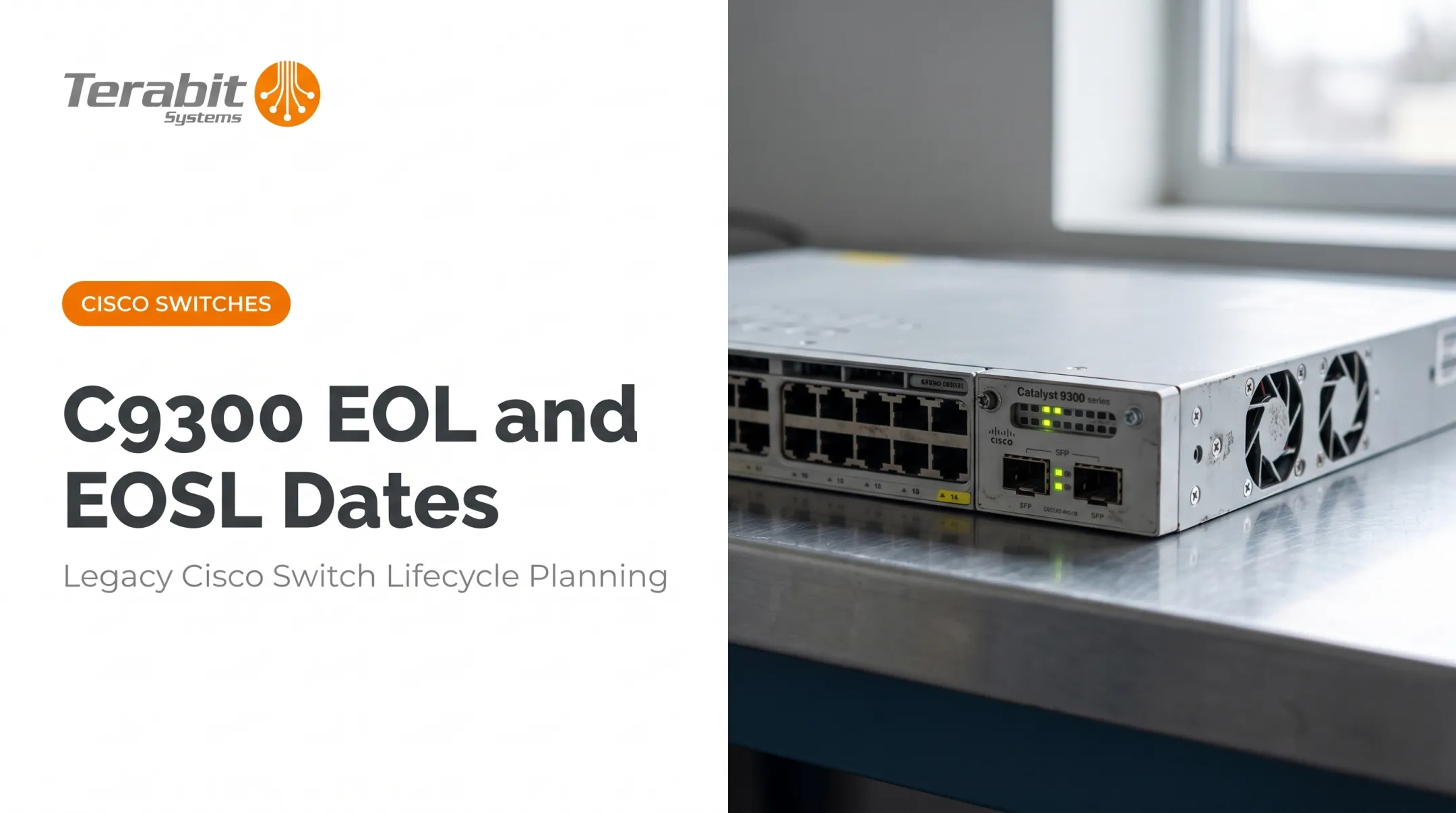

If you're running C9500 switches in your core or aggregation layer, you need to know exactly which SKUs are affected, what the actual dates are, and what your realistic options look like. Not every C9500 model is on the chopping block, but the ones that are require planning now, not later.
This guide breaks down the EOL/EOS timeline, the risks of running unsupported core hardware, the official Cisco replacement paths, and how buying refurbished C9500 units can stretch a tight budget without leaving you exposed.
Key Takeaways
- C9500-12Q, C9500-24Q, and C9500-40X hit End-of-Sale; security support ends April 30, 2029
- C9500-16X and newer variants (32C, 32QC, 48Y4C) are unaffected by this bulletin
- Cisco maps each EOL model to a specific successor with different port speeds and optics requirements
- Refurbished C9500 units bridge the gap for teams not ready for a full refresh
- Running EOL core switches past last support creates security and compliance exposure
What Is the Cisco Catalyst 9500 Series?
The Catalyst 9500 is Cisco's fixed-configuration switching platform built for the core and aggregation layer of enterprise campus networks and data center backbones. It belongs in the backbone, not at the access edge. You'll typically find it where high-throughput, low-latency performance matters most.
Is the C9500 a core switch? Yes. Cisco positions the entire series as its lead enterprise core and aggregation platform, built to handle the traffic volume that access switches feed upstream.
The C9500 runs Cisco IOS-XE and supports StackWise Virtual (SVL), which pairs two physical switches into one logical switch. That gives you chassis-like redundancy without buying an actual modular chassis, which is a big reason many teams chose this platform in the first place.
Cisco C9500 EOL and EOS Timeline: What's Been Announced
Two dates matter here, and they're often confused:
- End-of-Sale (EOS): The last day Cisco will sell you the product new
- End-of-Life (EOL) / Last Date of Support: When all software, security, and hardware support stops completely
The gap between them can span years. You can't buy new units after EOS, but you're not immediately unsupported either — and that window is where secondary-market inventory still covers production needs.
Which Models Are Affected
Cisco's April 30, 2023 bulletin names exactly three fixed-configuration models: C9500-12Q, C9500-24Q, and C9500-40X.
| Milestone | Date |
|---|---|
| EOL announcement | April 30, 2023 |
| End of Sale (last day to order) | April 30, 2024 |
| Last ship date | July 30, 2024 |
| End of software maintenance | April 30, 2025 |
| Service contract renewal ends | July 29, 2028 |
| Security support / Last Date of Support | April 30, 2029 |

Cisco also confirms IOS XE 17.18 EM is the last supported release train for these models, with 17.18.1 as the final maintenance release.
What's Not Affected
The C9500-16X, along with newer variants like the C9500-32C, C9500-32QC, and C9500-48Y4C, are explicitly excluded from this bulletin. Always verify exact status through Cisco's official End-of-Life tool, since dates and scope vary by part number and can change. For the three affected models, used and refurbished units remain a practical path through the support window ending in 2029.
Why You Shouldn't Ignore an EOL Core Switch
Once you pass the Last Date of Support, Cisco stops issuing security patches and TAC won't touch your case. For a device sitting in your network core, that's not a minor inconvenience.
Three risks compound as you approach and pass LDOS:
- Unpatched vulnerabilities: New CVEs affecting your IOS-XE version simply won't get fixed
- Compliance exposure: PCI-DSS, HIPAA, and SOC 2 expect documented risk management for unsupported infrastructure; auditors flag EOL gear in the traffic path
- Parts scarcity: OEM stock for RMA replacements dries up, and pricing on remaining inventory climbs fast
Cisco's general lifecycle policy typically offers five years of hardware TAC support and RMA parts availability from EOS. For the C9500 wave specifically, security support runs to April 2029. "Supported" and "actively maintained" are not the same thing: software maintenance already ended in April 2025.
The practical move: inventory your exact PIDs and IOS-XE versions now, document your patching and monitoring posture, and don't wait until an auditor flags it.
Upgrade and Replacement Paths for Affected C9500 Models
Cisco has mapped each EOS model to a direct successor:
| EOL Model | Cisco Successor | Key Change |
|---|---|---|
| C9500-12Q | C9500-32QC | 40G/100G QSFP28 density |
| C9500-24Q | C9500-32C | Higher 40G/100G port count |
| C9500-40X | C9500-48Y4C | 25G edge ports + 100G uplinks |

These successors keep the same IOS-XE feature set, which eases configuration migration. But don't assume it's a drop-in swap. The port speeds and optic types shift meaningfully: the 32C, for instance, only supports breakout on 24 of its 32 ports due to an ASIC limitation.
Before you order anything, budget for:
- New optics/transceivers: successor models often require different SFP/QSFP types than your existing gear
- StackWise Virtual re-validation: Cisco's SVL guide requires Cisco-branded transceivers and Network Advantage licensing, so pairs need coordinated testing
- A migration window: teams running VSS or StackWise Virtual pairs should plan a coordinated swap to avoid a core outage mid-migration
Alternative: Extend the Runway with Refurbished C9500 Hardware
Not every team is ready to jump straight to new hardware, and not every team needs to. Budget-conscious IT shops, ISPs, and Tier-2 cloud providers often buy tested pre-owned C9500 units (including EOS models still within their useful hardware life) to bridge a budget cycle without rushing a refresh.
This is where Terabit Systems fits in. We test and certify refurbished Cisco Catalyst 9500 switches through a five-step QA process:
- Physical inspection
- Functional and wire-speed port testing
- Factory reset
- Cosmetic refurbishment
- Final kitting

Every unit ships with a first-year replacement-or-refund warranty, so you're not gambling on secondary-market gear.
For teams that need to replace a failing unit or expand capacity without paying new-hardware prices, that combination of testing and warranty coverage matters more than a lower price tag alone.
Should You Buy, Trade-In, or Hold Onto Your Current C9500 Gear?
Not every EOS unit needs to leave your network tomorrow. Here's how to prioritize:
- Hold non-critical EOS units while you secure refresh budget; the hardware still works after EOS when risk exposure is low
- Replace production and core-facing switches first; they carry the compliance and security exposure auditors and attackers care about
- Trade in or sell surplus units once you decommission them in a refresh

When you do need replacements, buying refurbished C9500 gear (or a successor platform) usually costs far less than OEM list price. Trade-in is the step teams skip. Decommissioned C9500 units can go to Terabit Systems for fair-market value or trade-in credit toward refurbished replacements—so refresh spend drops instead of surplus sitting in a closet or going to disposal.
Frequently Asked Questions
Is the Cisco C9500 EOL?
Only specific models (C9500-12Q, C9500-24Q, and C9500-40X) have received EOS/EOL announcements. Other models in the series remain active. Check your exact SKU on Cisco's EOL tool to confirm.
Is a Cisco 9500 a core switch?
Yes. The C9500 is built as a core and aggregation-layer switch for enterprise campus and data center networks, not typically deployed at the access layer.
What's the difference between End-of-Sale and End-of-Life?
End-of-Sale marks when Cisco stops selling a model as new. End-of-Life (Last Date of Support) is years later, when all software, security, and hardware support stop entirely.
Can I still buy Cisco C9500 switches after EOS?
Yes, through the refurbished/pre-owned market. Resellers like Terabit Systems test EOS models and back them with warranties, so they remain a viable option after Cisco stops selling them new.
What is the replacement for the C9500-40X?
Cisco recommends the C9500-48Y4C as the direct successor, offering 25G edge port density with 100G uplink capacity.
What should I do with my old C9500 switches after upgrading?
Contact an ITAD/resale partner like Terabit Systems for a free audit and buy-back quote instead of scrapping or storing the decommissioned units.