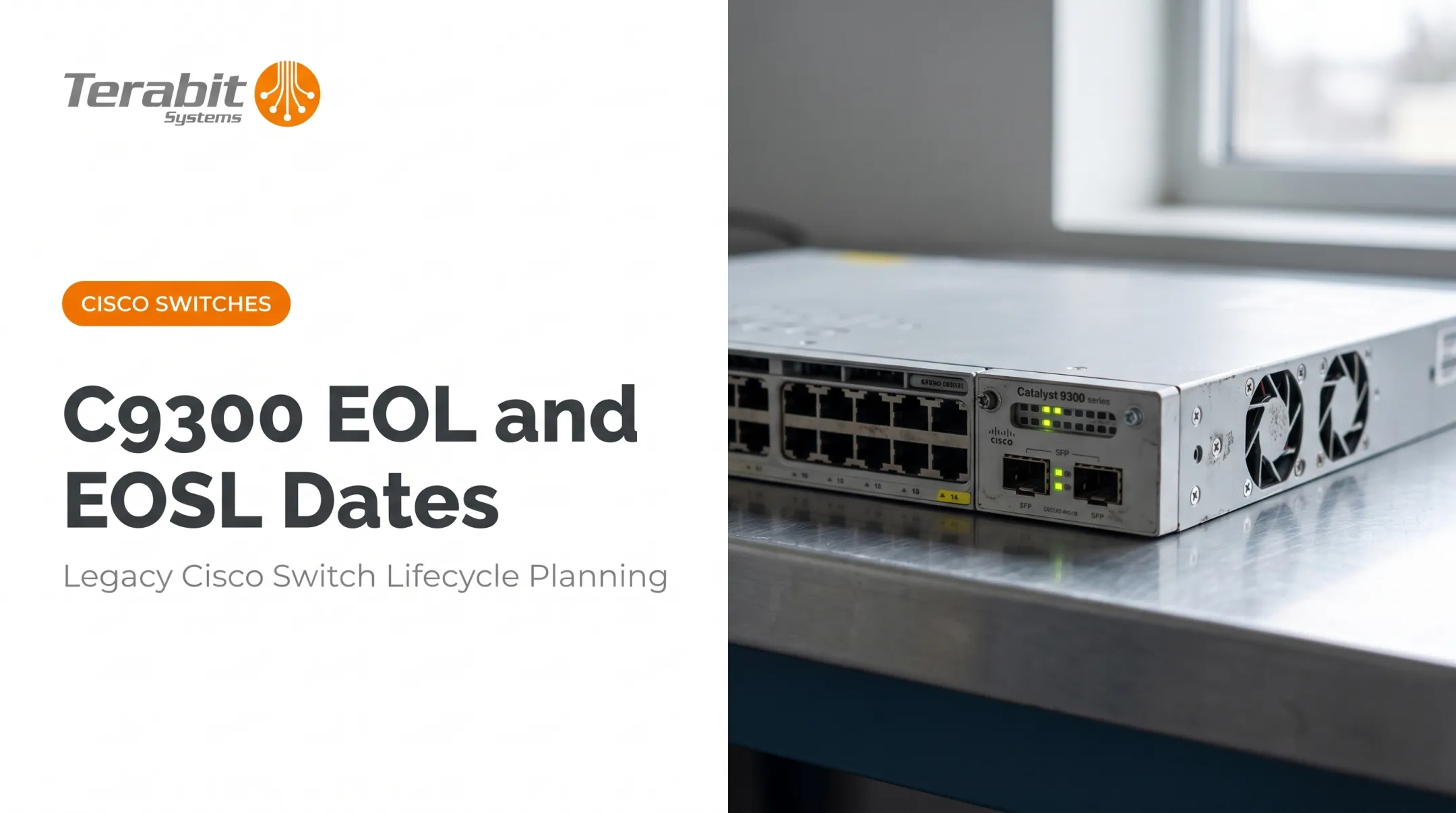

Choosing wrong here isn't a small mistake. Pay for -A and never touch Layer 3 routing, and you've overspent for nothing. Buy -E and later need VLAN routing across sites, and you're stuck relicensing or replacing hardware mid-project.
This guide breaks down the hardware, the licensing tiers, real use cases, and what to consider when buying — including refurbished options that change the math entirely.
TL;DR
- Both switches share identical hardware: 24 x 1G copper ports, modular uplinks
- The only real difference is the Network Stack license — Advantage (-A) vs Essentials (-E)
- -A unlocks full OSPF, EIGRP, and BGPv4 routing plus advanced segmentation
- -E covers Layer 2 switching plus limited routed access (RIP, EIGRP Stub, OSPF up to 1,000 routes)
- Refurbished sourcing can put -A's routing power within reach of an -E budget
C9300-24T-A vs C9300-24T-E: Quick Comparison
| Factor | C9300-24T-E | C9300-24T-A |
|---|---|---|
| Licensing tier | Network Essentials | Network Advantage |
| Routing capability | Layer 2 + limited routed access (RIP, EIGRP Stub, OSPF capped at 1,000 routes) | Full OSPF, EIGRP, BGPv4, plus VRF, VXLAN, TrustSec |
| Cost | Lower upfront cost | Higher upfront cost due to premium license |
| Ideal use case | Access layer, simple connectivity | Distribution/segmentation-heavy networks |
| Software compatibility | DNA Essentials subscription | Full DNA Advantage/Catalyst subscription |
According to Cisco's Catalyst 9300 data sheet, Essentials isn't a bare-bones Layer 2 tier — it supports routed access and small-scale routing. The real split appears when you need advanced dynamic routing at scale.

What Is C9300-24T-A?
The C9300-24T-A is the Network Advantage-licensed version of the 24-port copper Catalyst 9300. It's the same physical switch as the -E model, just with a different network stack license activated.
What Advantage unlocks:
- Full OSPF, EIGRP, and BGPv4 routing protocols
- VRF, VXLAN, LISP, and Cisco TrustSec segmentation
- Full compatibility with Cisco DNA Advantage/Catalyst subscriptions
- Support for SD-Access architectures
The "-A" designation isn't a separate hardware build. It's tied to the Network Stack SKU that ships with the unit.
Use Cases of C9300-24T-A
The -A model fits scenarios where the access switch needs to do more than forward packets:
- Campus distribution layers where segmentation between departments matters
- Branch offices that need local routing without a dedicated router
- SD-Access deployments requiring policy-based automation
Cisco's own Campus LAN design guide notes that pushing Layer 3 into the access layer eliminates spanning-tree loops and lets both uplinks carry traffic actively. That matters for networks tired of managing STP convergence issues.

What Is C9300-24T-E?
The C9300-24T-E is the same hardware platform, licensed with Network Essentials instead. It remains a full IOS-XE switch; Network Essentials simply ships a lighter routing feature set.
What Essentials includes:
- Full Layer 2 switching (VLANs, trunking, STP, etc.)
- Routed access: static routing, RIP, EIGRP Stub
- OSPF, but capped at 1,000 routes
- Policy-based routing (PBR) and limited PIM Stub Multicast
You can't unlock -A features on an -E unit with a software update alone. Moving from Essentials to Advantage means buying a Network Advantage license and activating it — a licensing transaction, not a firmware patch.
That lighter feature set is exactly why -E shows up in simpler access roles.
Use Cases of C9300-24T-E
The -E model is a strong fit when routing simply isn't part of the job:
- Classroom and campus access closets
- Retail branch connectivity
- VOIP/data closets with no VLAN routing requirements
VARs building cost-optimized refreshes often default to -E. Many organizations start here and only move to -A when more VLANs, sites, or segmentation push past what Essentials covers.
C9300-24T-A vs C9300-24T-E: What's Better?
There's no universal winner. The decision hinges on three questions:
- Do you need dynamic routing protocols today? If OSPF beyond 1,000 routes, EIGRP, or BGP is on your roadmap, -A is the answer.
- Is SD-Access or heavy segmentation part of your plan? VRF, VXLAN, and TrustSec are Advantage-only.
- What's the budget reality? -E costs less upfront and covers most access-layer deployments.

Situational recommendation:
- Choose -A if you need Layer 3 routing now or expect to scale into SD-Access
- Choose -E if reliable Layer 2 switching at a lower price point is all you need
- Consider a refurbished -A if you need Advantage features but want to stay near new -E pricing
A refurbished C9300-24T-A from a trusted reseller like Terabit Systems can land full routing capability near the price of a new -E. The license tier no longer has to be a budget sacrifice.
Real World Example: Choosing the Right License Tier
The following is an illustrative scenario, not a documented customer case.
Picture a mid-size ISP planning a network refresh across three regional offices. Each site needs VLAN segmentation for guest, staff, and management traffic, with routing between them.
Budget was set around new C9300-24T-E pricing. That tier's 1,000-route OSPF cap and lack of BGP support wouldn't scale with their growth plans.
The team's challenge: fund routing capability without blowing the budget on new -A hardware.
Their solution was sourcing refurbished C9300-24T-A units instead of new -E switches. Refurbished Advantage-tier hardware, tested and backed by warranty, landed close to what new Essentials units would have cost. The network kept the routing headroom it needed.

The takeaway: refurbished sourcing can let a team "upgrade" their licensing decision without inflating total spend. Instead of choosing between budget and capability, they got both.
If you're weighing a similar decision, request a free quote from Terabit Systems to compare refurbished -A pricing against new -E units, or explore a trade-in evaluation for gear you're retiring.
Conclusion
The C9300-24T-A and C9300-24T-E share the same Catalyst 9300 hardware. The decision comes down to whether Layer 3 routing is required now or on the near horizon.
Match the license tier to your network needs and budget, not the other way around. When budget is the constraint rather than features, refurbished units from Terabit Systems can get you higher-tier licensing without the higher-tier price tag.
Frequently Asked Questions
What are the different models of the Cisco Catalyst 9300 switches?
The family includes the 9300L (fixed uplinks), 9300 (modular uplinks), 9300X (high-performance), and 9300LM (compact). They vary by port count, uplink speed, and performance tier.
What is C9300-24S-A?
The C9300-24S-A is the 24-port SFP (fiber) model with Network Advantage licensing. It matches the -24T-A for full Layer 3 routing, but uses fiber SFP ports instead of copper.
Can a C9300-24T-E be upgraded to C9300-24T-A?
Yes, but you buy a Network Advantage license and activate it in software, not through a hardware swap. Both models run the same IOS-XE image.
Is buying a refurbished Cisco Catalyst 9300 switch reliable?
Reputable resellers put units through rigorous testing and back them with warranties. Terabit Systems, for example, runs a five-step QC process and offers a one-year replacement-or-refund guarantee.
Does the C9300-24T-A require a separate DNA subscription?
Yes. Cisco requires a Network Stack license plus a separate term-based Catalyst/DNA software subscription for full functionality.
Which switch is better for a small business with no routing needs?
The C9300-24T-E. It handles access-layer switching reliably at a lower cost when Layer 3 routing isn't part of the requirement.