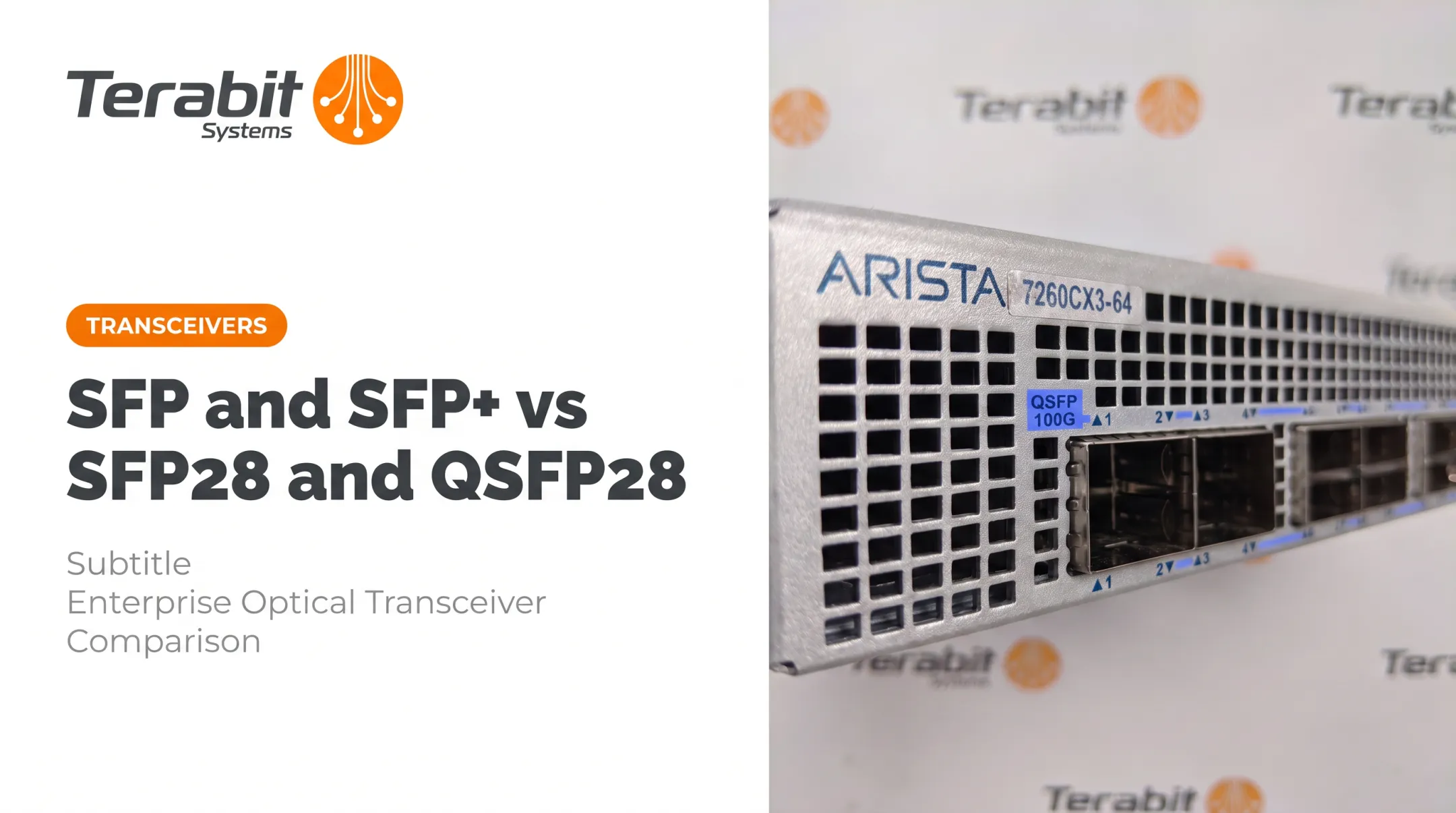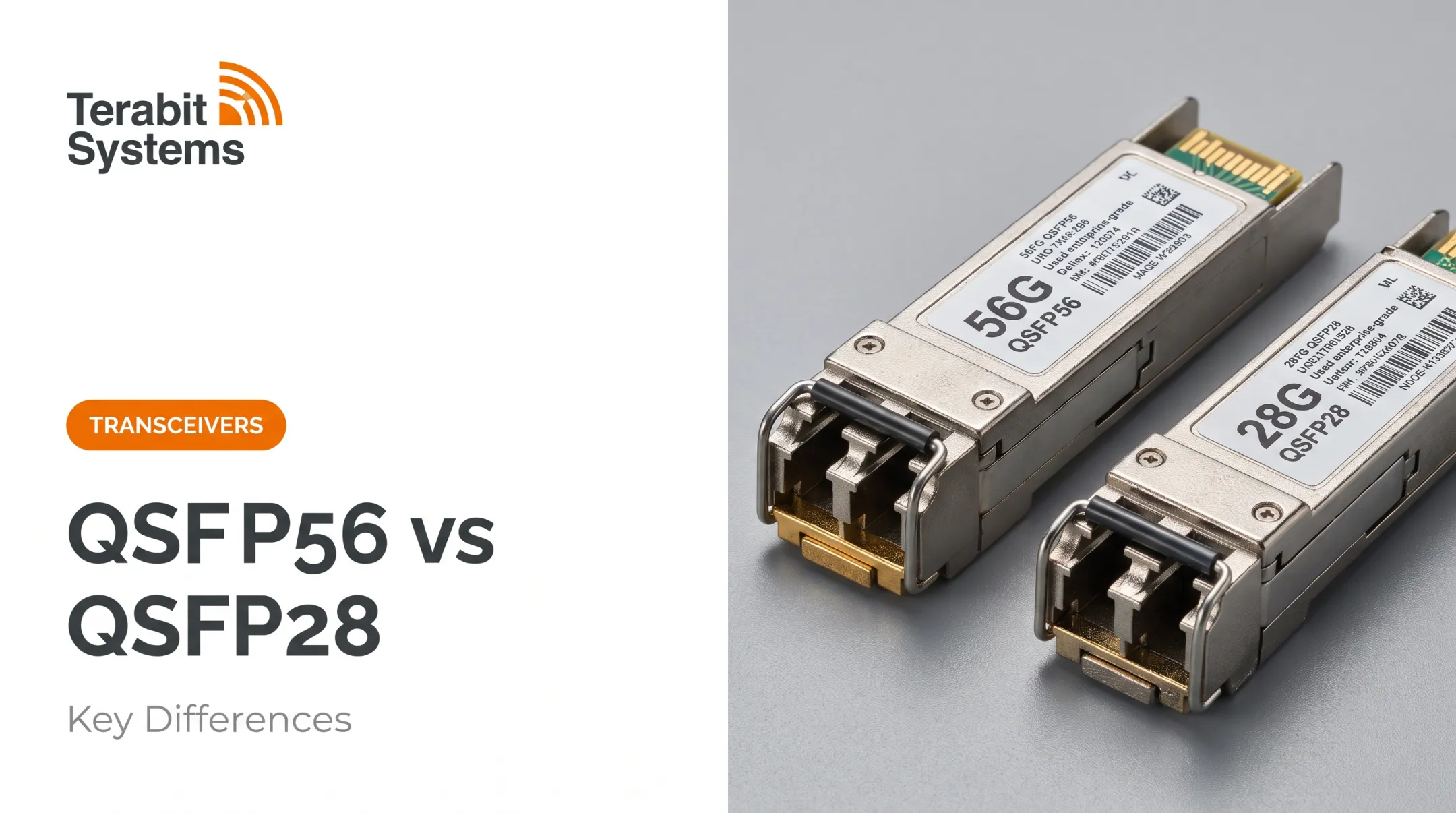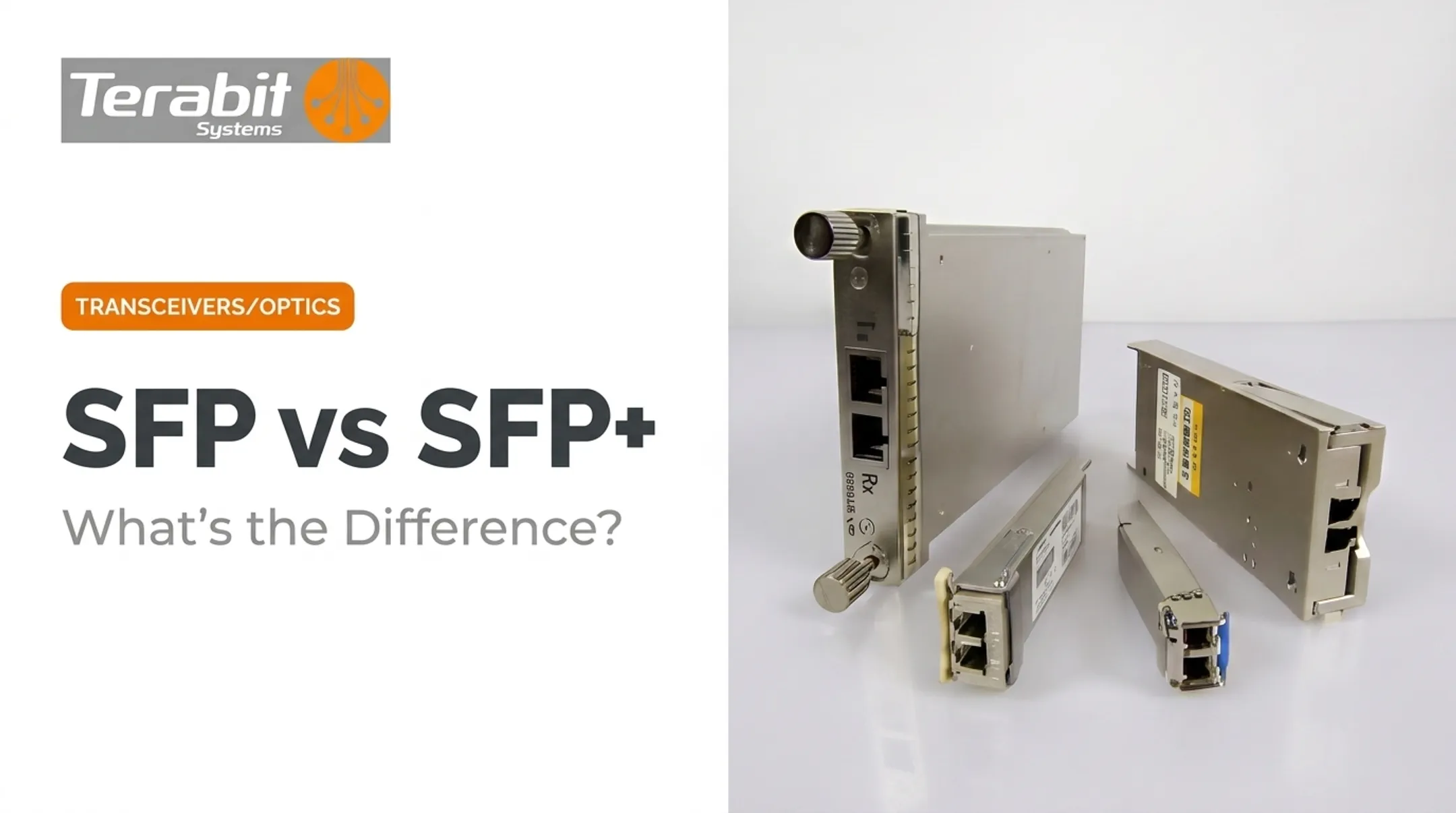

Many IT teams struggle with this exact decision when planning a network refresh. They look identical. They fit the same cage. But one runs at 10Gbps and the other pushes 25Gbps or more, and mixing them up on a purchase order gets expensive fast.
Terabit Systems works with Tier-2 cloud providers, regional ISPs, and enterprise IT teams every day sourcing refurbished SFP28 and SFP+ hardware at a fraction of OEM list pricing. This guide breaks down what SFP28 actually is, how it compares to SFP+, whether the two are compatible, and how to choose the right module for your network.
Key Takeaways
- SFP28 hits up to 25/28Gbps versus SFP+ at 10Gbps—same physical form factor
- Dual-rate SFP28 modules are typically backward compatible with SFP+ ports (single-rate ones are not)
- Choose optics by link distance, fiber type, and switch/NIC support—not speed rating alone
- Refurbished, tested SFP28/SFP+ transceivers cut hardware cost versus buying new from the OEM
What is an SFP28 Module?
SFP28 stands for "Small Form-factor Pluggable 28." It's the third generation in the SFP family, following SFP and SFP+. The "28" refers to the maximum electrical interface speed the module supports, not the line rate most links run in production—typically 25GbE.
SFP28 covers more than just optical transceivers. The category includes:
- Optical transceivers (SR, LR, ER variants)
- DAC (direct-attach copper) cables
- AOC (active optical cable) assemblies
These are standardized under SFF-8402, which defines the physical, electrical, and management interface for the SFP+ 1x family — SFP28 included. IEEE 802.3by supplies the 25 Gigabit Ethernet standard that most SFP28 deployments are built around.
The Electrical Interface Upgrade
SFP28 uses 28Gbps NRZ signaling on its electrical interface, which is what sustains a full 25G data rate over the link. That upgrade needed tighter impedance control and connector tolerances than the original SFP+ spec required.
You'll find SFP28 ports on:
- Data center switches (leaf/spine architectures)
- Network interface cards (NICs) in servers
- Baseband units (BBUs) supporting 32G Fibre Channel
Cisco flagged this shift early. Back in January 2018, Cisco forecast that 25GbE ports were poised to become the most prevalent data center server access ports within five years — a call that held up as cloud and AI workloads moved server access well past 10G and made 25G the default step up.
SFP28 vs SFP+: What's the Difference?
The headline difference is speed, but several other attributes shape how you design and cost the network.
| Attribute | SFP+ | SFP28 |
|---|---|---|
| Max data rate | 10G (up to 16G Fibre Channel) | 25G (up to 32G Fibre Channel) |
| Governing standard | SFF-8431 / 10GbE | SFF-8402 / IEEE 802.3by |
| Common wavelengths | 850nm, 1310nm, 1550nm | 850nm, 1310nm (LR/ER variants) |
| Connector | LC duplex | LC duplex |
| Typical reach (SR example) | 300m OM3 / 400m OM4 | 70m OM3 / 100m OM4 |
| Max power draw (example) | ~1.0W | ~1.2–1.5W |

Note: reach and power figures above are drawn from Cisco's published SFP-10G-SR and SFP-25G-SR-S datasheets (actual specs vary by manufacturer and SKU).
SFP28 also improves signal integrity. Tighter impedance control and reduced crosstalk push more bandwidth through the same footprint, which matters as port density rises in spine-leaf designs.
Cost-Per-Gigabit Math
SFP28 modules cost more per unit than SFP+. But the math changes when you look at cost-per-Gbps:
- 4x 25G SFP28 builds a 100G link with 4 ports and 4 cables
- 10x 10G SFP+ needs 10 ports and 10 cables for the same 100G capacity
- Fewer ports and cables free rack space and simplify cabling
- Switch chassis cost per Gbps delivered is often lower at 25G
That is why migration can make financial sense even when the per-unit SFP28 price is higher.

One thing that hasn't changed: both form factors share identical physical dimensions under SFF-8432/SFF-8472. Mechanically, an SFP28 module will drop into an SFP+ cage without issue. Whether it operates correctly is a separate question, and that comes down to compatibility.
Is SFP28 Compatible with SFP+?
Short answer: mechanically, yes. Electrically, it depends on the specific module.
Because SFP28 and SFP+ share the same physical envelope, you can usually insert an SFP28 module into an SFP+ port and vice versa. That's where the guarantees stop.
Here's what actually happens in practice:
- Dual-rate SFP28 modules (labeled 10G/25G) are designed to negotiate down and operate at 10G in an SFP+ port. Cisco's SFP-10/25G-LR-S is a documented example.
- Single-rate 25G-only SFP28 modules may not negotiate correctly in an SFP+ port at all. Some won't link up; others will report errors.
- SFP+ transceivers plugged into SFP28 ports will run at 10G (or whatever the port's max supported rate is). They will never reach 25G, regardless of what the port is capable of.
- Vendor behavior isn't universal. Arista, for instance, sells ordinary 25G-SR modules and separate dual-rate "MR" variants in its catalog — the two are not interchangeable in terms of backward operation.
Always check your switch or NIC vendor's compatibility matrix before mixing module types. A part number that works in a Cisco Nexus switch isn't automatically validated for a Juniper QFX or Arista 7000-series port.

Types of SFP28 Transceivers and Their Applications
SFP28 optics break down into a few standard reach categories, plus copper and active-optical cable options for shorter links.
- SR (Short Reach): Multimode fiber, typically up to 70–100m depending on OM3/OM4 grade. Best for in-rack and adjacent-rack connections.
- LR (Long Reach): Singlemode fiber, roughly 10km. Common for building-to-building or campus-scale links.
- ER (Extended Reach): Singlemode fiber, up to 40km. Used for metro-scale or long inter-facility connections.
- DAC/AOC cables: Direct-attach copper or active optical cables for short in-rack or inter-rack runs. They cost less than discrete optics for runs under 5–10 meters.
Those reach options show up most often in:
- Data center spine-leaf fabrics that need dense 25G leaf uplinks
- 5G fronthaul and midhaul links between radio and aggregation sites
- Enterprise core upgrades moving from 10G to 25G
- HPC and SAN storage fabric interconnects

Choosing the Right SFP28 Module for Your Network
Picking the right module comes down to three variables: distance, existing fiber plant, and switch compatibility.
Start with distance and your fiber plant. Short runs inside a rack or row usually call for SR over multimode OM3/OM4. Singlemode plants open the door to LR and ER for longer campus or metro runs without a fiber upgrade.
Then verify compatibility before you buy anything. Not every "SFP28" label behaves the same way in every port. Check:
- Vendor support matrix for the exact switch/NIC model
- Whether the module is single-rate or dual-rate
- FEC (Forward Error Correction) requirements at 25G — many modules need RS-FEC enabled to hit full reach
- DOM/DDM (Digital Diagnostic Monitoring) support for ongoing link-health visibility
A trusted reseller closes the gap between datasheet claims and what actually works in your gear. Terabit Systems tests refurbished SFP28 and SFP+ modules by passing live traffic through them before resale, checks diagnostics where applicable, and backs sold hardware with warranty coverage.
That mix of OEM-spec performance testing and a lower price than new helps Tier-2 providers and enterprise IT teams stretch budgets without gambling on unverified gear. Quote-based volume pricing is available for bulk orders.
Frequently Asked Questions
Can I use SFP28 in an SFP+ port?
Yes, if the SFP28 module is a dual-rate (10G/25G) model and your switch supports it. Single-rate 25G-only modules may fail to negotiate correctly in a 10G-only port.
Is SFP28 the same as SFP+?
No. They share the same physical form factor and connector, but SFP28 supports higher data rates (up to 25/28Gbps) than SFP+'s 10Gbps ceiling.
What does SFP28 mean?
"SFP28" stands for Small Form-factor Pluggable with a 28Gbps maximum electrical interface, primarily used to support 25G Ethernet and 32G Fibre Channel links.
What is an SFP and what is it used for?
An SFP is a hot-pluggable transceiver module that connects network gear to fiber optic or copper cabling. It lets you swap modules without powering down the equipment.
How many types of SFP are there?
The main types are SFP, SFP+, SFP28, SFP56, and SFP-DD, each with higher data rates—from 1Gbps up to over 100Gbps when channels are combined.
How can I tell if an SFP is multimode or single-mode?
Check the module label or part number, which usually shows wavelength (850nm is typical for multimode; 1310/1550nm for single-mode). The manufacturer’s datasheet confirms the exact type.