
This confusion trips up a lot of network engineers and procurement teams, especially when FCoE, OTN, or TAA compliance enters the conversation. This guide breaks down the real differences, the specs that stay the same, and how to pick the right module without guessing.
Key Takeaways
- SFP-10G-SR and SFP-10G-SR-S share identical optics: 850nm, 300m on OM3, 400m on OM4, LC duplex
- The real difference is protocol support: SR handles FCoE, OTN, and WAN-PHY; SR-S doesn't
- SR-S costs less and skips TAA compliance, making it the go-to for standard enterprise Ethernet
- Compatible and refurbished modules often erase this distinction entirely at a lower price
SFP-10G-SR vs SFP-10G-SR-S: Quick Comparison
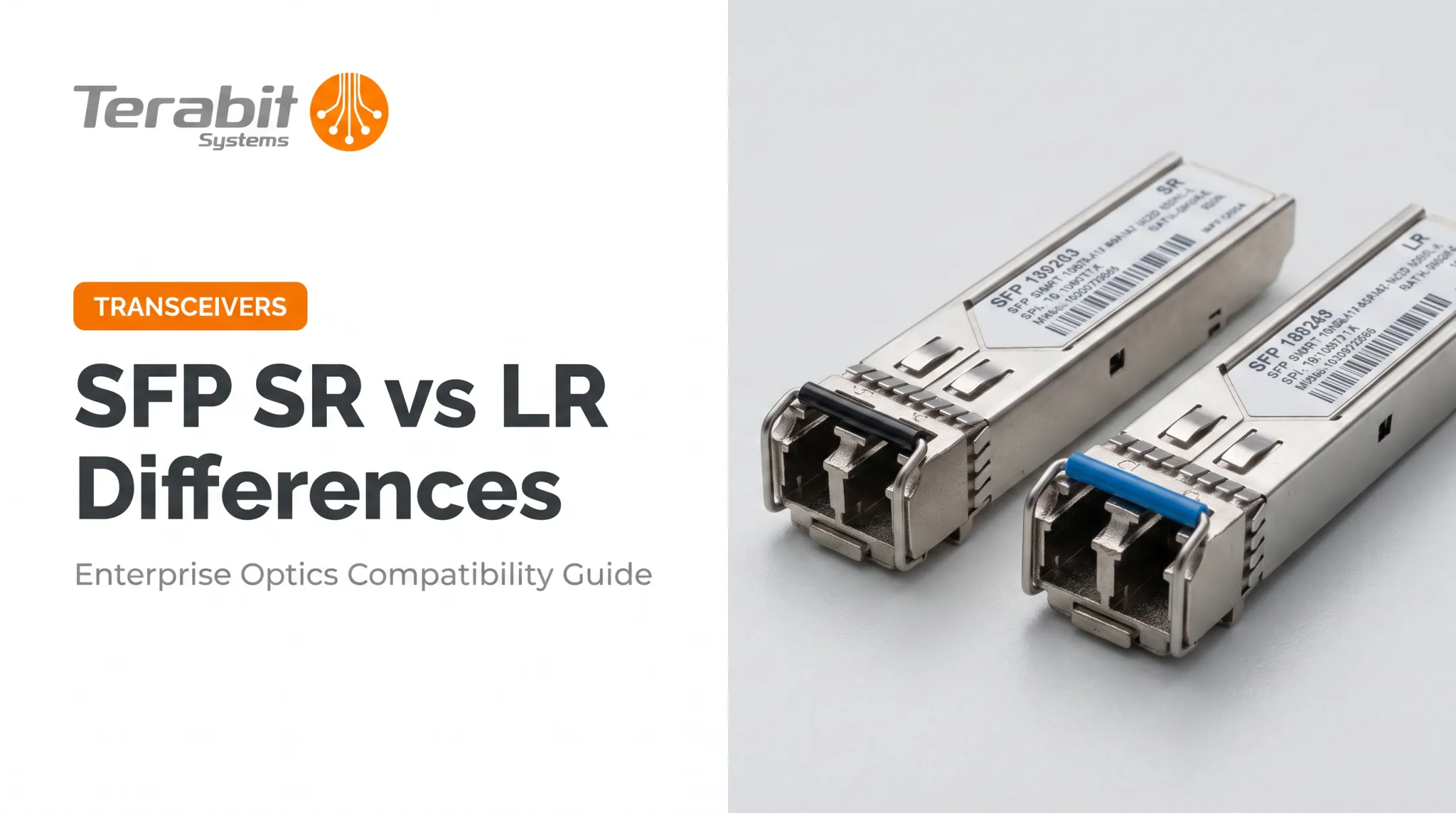
Cisco's current datasheet confirms these two modules are optically identical. The differences live entirely in feature support and compliance status.
| Attribute | SFP-10G-SR | SFP-10G-SR-S |
|---|---|---|
| Wavelength | 850nm, MMF | 850nm, MMF |
| Link distance | 300m (OM3) / 400m (OM4) / 26m (FDDI-grade) | Same as SR |
| FCoE support | Yes | No |
| OTN / WAN-PHY | Yes | No |
| TAA compliance | Yes | No |
| Relative cost | Slightly higher | Lower ("S-Class" pricing) |
The takeaway: if you're just running 10G Ethernet between switches, both modules will hit the same link. The decision comes down to whether you need FCoE, OTN, WAN-PHY, or TAA — not distance or speed.

Understanding SFP-10G-SR and SFP-10G-SR-S
What Is SFP-10G-SR?
SFP-10G-SR is Cisco's original, full-featured 10GBASE-SR SFP+ transceiver. It's built for short-reach multimode fiber links but carries the complete feature set: FCoE, OTN, and WAN-PHY support, plus TAA compliance.
That makes it the module of choice for:
- Fibre Channel over Ethernet SAN environments
- Telecom deployments requiring OTN transport
- Federal or government contracts where TAA compliance under FAR 52.225-5 is a hard requirement
TAA rules aren't about optical performance — they're about country of origin. Federal buyers need documented proof the exact orderable part meets Trade Agreements Act sourcing rules, not just a family-level assumption.
What Is SFP-10G-SR-S?
SFP-10G-SR-S is Cisco's "S-Class" variant — a commercial-only version stripped of the protocols most enterprise buyers never touch. Removing FCoE, OTN, and WAN-PHY support cuts manufacturing complexity, and Cisco passes that savings on through a lower price tag.
It's the more popular pick for:
- Standard switch-to-switch or switch-to-server 10G Ethernet links
- Data center environments with no Fibre Channel requirement
- Enterprise buyers who don't need TAA documentation
For budget-conscious buyers, that OEM split often disappears in the compatible and refurbished market. Tested third-party and refurbished modules — including those from Terabit Systems — typically support the full feature range regardless of the OEM part number, at a single price point.

Which One Should You Choose?
Ask yourself one question first: do you need FCoE, OTN, WAN-PHY, or TAA compliance?
- Yes → Go with SFP-10G-SR. FCoE SANs, OTN networks, and federal/public-sector buys need documentation the S-Class variant can't provide.
- No → Go with SFP-10G-SR-S. For plain 10G Ethernet in an enterprise or data center—with no Fibre Channel or government contract—don't pay for features you won't use.
For buyers who'd rather skip the guesswork, tested refurbished 10GBASE-SR modules from Terabit Systems (Cisco, Arista, and Juniper sourced) sidestep the SR vs. SR-S question.
Compatible units are typically interchangeable across use cases and come warranty-backed with a 1-year replacement guarantee, so you're not stuck choosing on a part-number technicality.

Real-World Scenario: Choosing the Right 10G Optic for a Data Center Refresh
Picture a regional ISP or Tier-2 cloud provider planning a switch refresh, moving legacy 1G links to 10G Ethernet across dozens of sites.
That kind of scaling isn't rare. Virgin Media Business Wholesale's Project Spark, for example, reported rolling out 10G services and 1G/10G aggregation across 23 core sites and 177 metro locations, cutting Ethernet lead times by 32% year over year.
The challenge: budget constraints collide with confusion over OEM part numbers. Procurement teams often default to the pricier SFP-10G-SR "just in case," even when nothing on the network touches FCoE or OTN.
The resolution: sourcing tested, compatible 10GBASE-SR SFP+ modules instead of paying OEM premiums for unused features. Terabit Systems' refurbished inventory (Juniper, Cisco, Brocade, and Arista optics) gives buyers standard 10GBASE-SR functionality without the added cost of protocol support they're never going to activate.

The takeaway: matching a transceiver's feature set to actual network requirements, rather than defaulting to the "safer-sounding" part number, avoids overspending on a refresh that didn't need the extra capability in the first place.
Conclusion
SFP-10G-SR and SFP-10G-SR-S are functionally near-identical for link distance and speed. Both hit 300m on OM3 and 400m on OM4 fiber. The real divide is FCoE, OTN, and WAN-PHY support, plus TAA compliance.
Base your decision on actual protocol requirements and compliance needs, not on which module "sounds" more capable. If you'd rather not track down the fine print for every deployment, tested refurbished optics simplify the choice and cut cost at the same time.
Frequently Asked Questions
What is the difference between SFP-10G-SR and SFP-10G-SR-S?
Both have identical optical specs, but SFP-10G-SR supports FCoE, OTN, and WAN-PHY and is TAA compliant. SFP-10G-SR-S (S-Class) omits these for a lower-cost, commercial-grade option.
Is SFP-10G-SR single-mode or multimode?
SFP-10G-SR is a multimode fiber (MMF) transceiver operating at 850nm, supporting up to 400m over OM4 fiber. It is not a single-mode module.
What does SFP SR stand for and what is its purpose?
SR stands for "Short Range/Reach." The module provides cost-effective 10 Gigabit Ethernet connectivity over short multimode fiber links within data centers and campus networks.
Can I use SFP-10G-SR-S in place of SFP-10G-SR?
SR-S works as a drop-in replacement for most standard Ethernet applications. It won't work, however, if your network requires FCoE, OTN, WAN-PHY, or TAA compliance.
Why is SFP-10G-SR-S cheaper than SFP-10G-SR?
S-Class optics remove non-essential protocol support to reduce manufacturing complexity and cost. Those savings get passed on to enterprise buyers who don't need those features.
Are compatible/refurbished SFP-10G-SR modules as reliable as OEM Cisco modules?
Reputable refurbished suppliers test each unit and back it with solid warranties. For most standard deployments, that makes them a reliable, lower-cost alternative to OEM pricing.