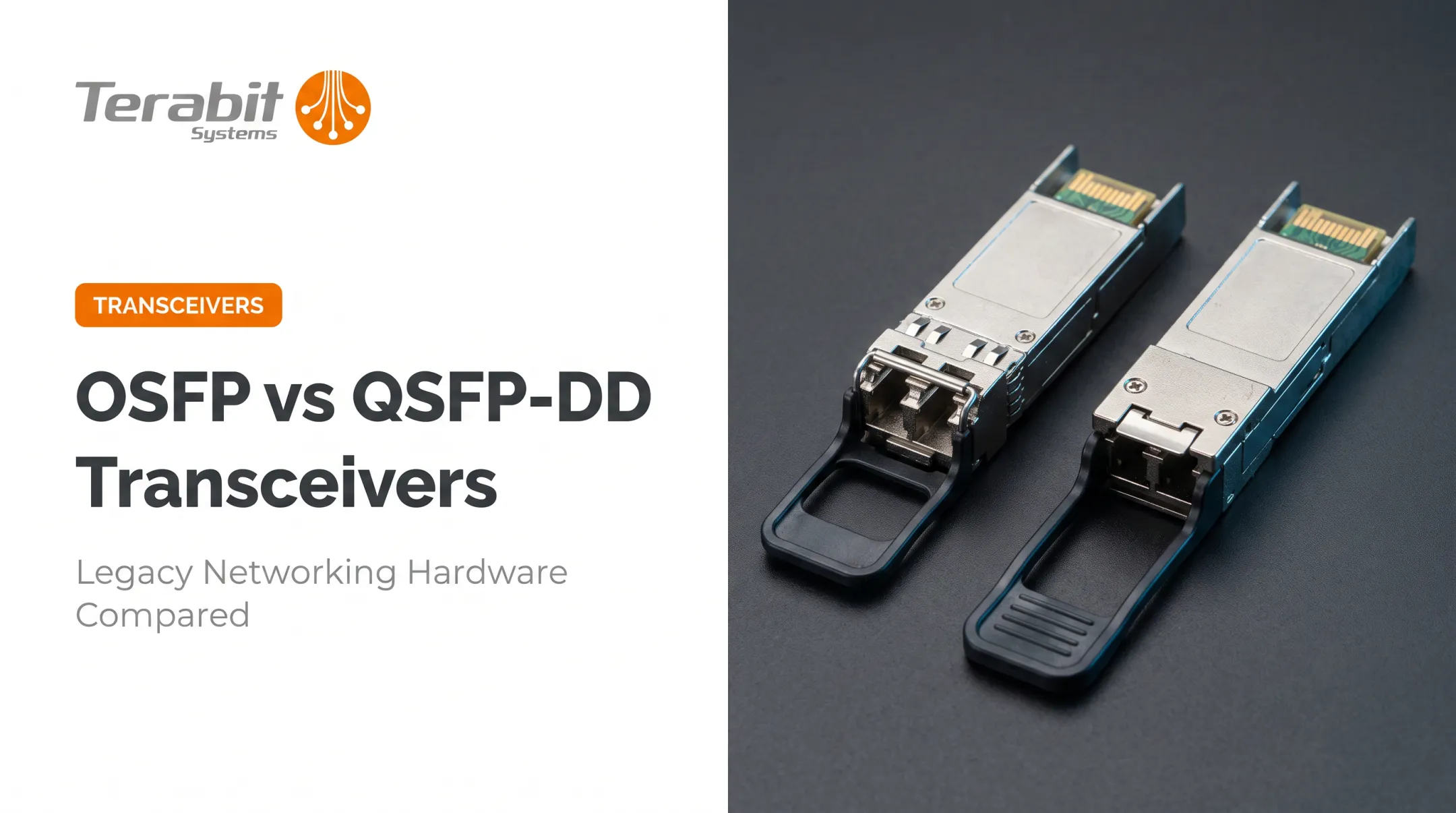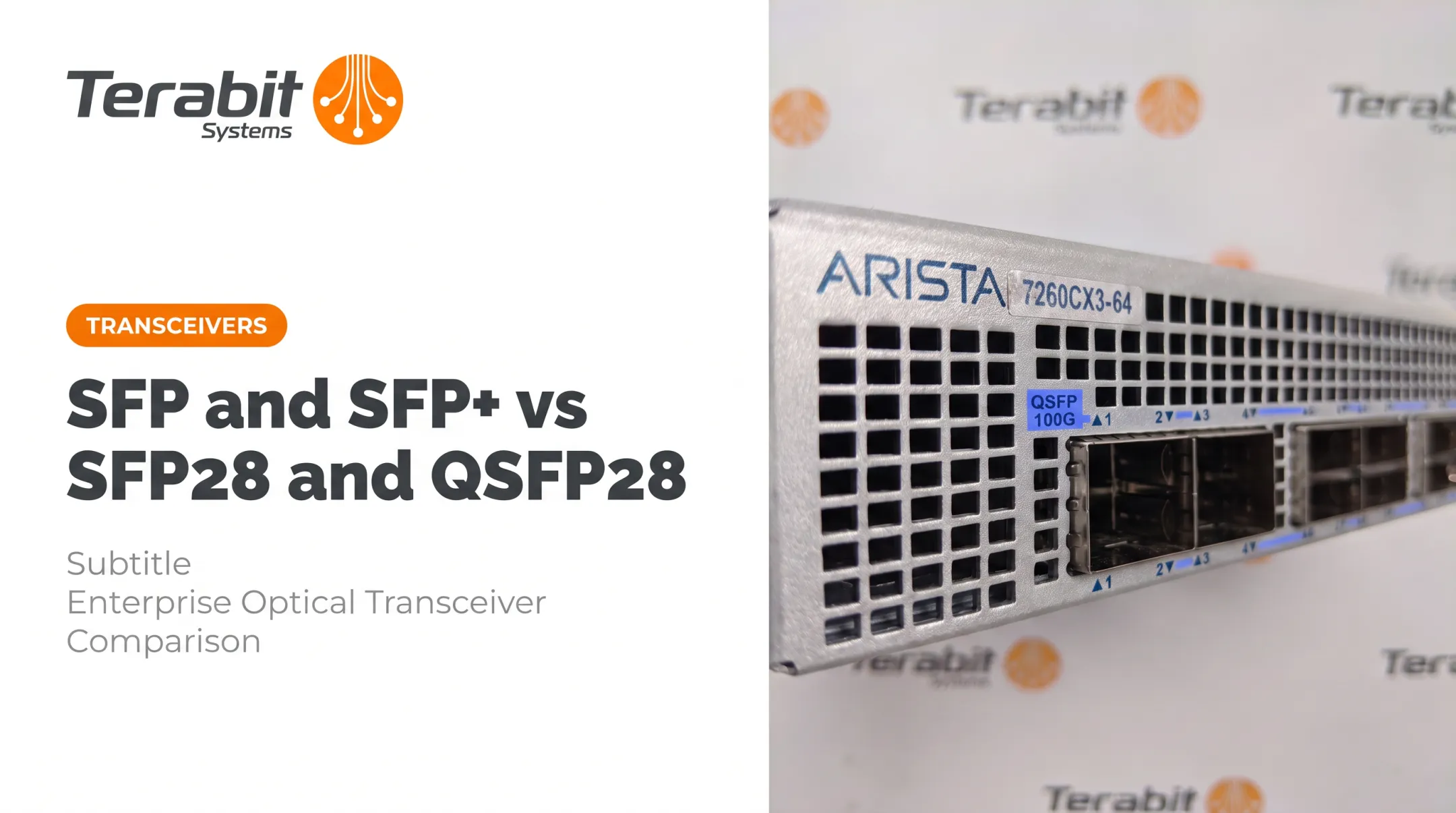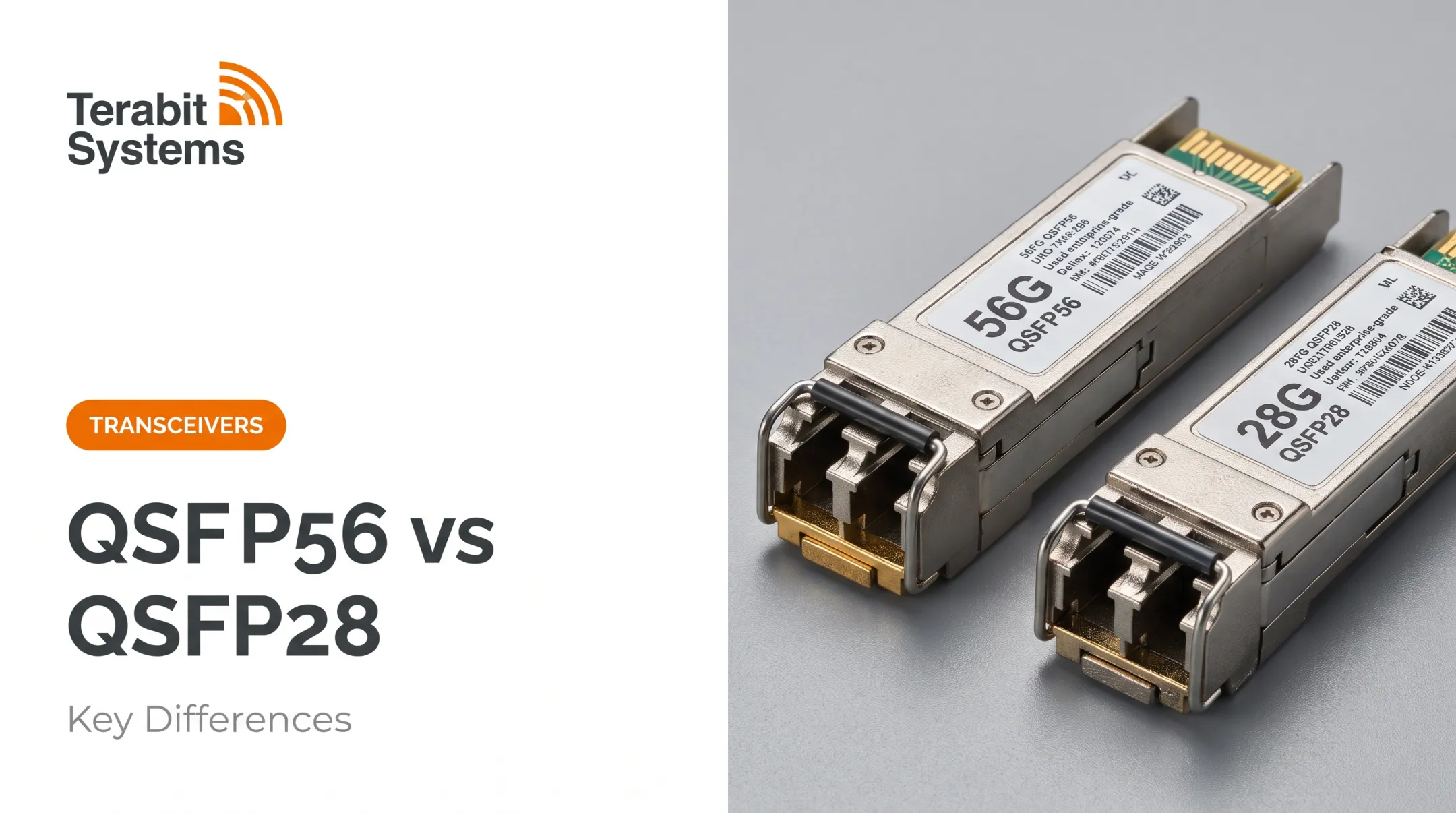

QSFP transceivers are one of the main tools engineers use to solve this. They pack four data channels into a single pluggable module, letting network teams scale bandwidth without ripping out existing chassis.
This article breaks down what a QSFP transceiver actually is, how it works, the different generations you'll encounter, and what to check before buying one — refurbished or new.
Key Takeaways
- QSFP stands for Quad Small Form-Factor Pluggable: four independent data channels in one connector.
- Generations range from original QSFP (4G) to QSFP-DD (400G) for different network speeds.
- QSFP+ and QSFP28 share a connector but run different speeds; port compatibility matters more than appearance.
- Refurbished QSFP modules from major brands cut hardware costs versus buying new from the OEM.
What Is a QSFP Transceiver?
QSFP stands for Quad Small Form-Factor Pluggable. It's a compact, hot-swappable module that plugs directly into a switch, router, or network interface card (NIC) to carry data in and out over fiber or copper.
The "quad" part is what matters in the rack. Unlike a standard SFP module, which handles a single data channel, a QSFP module bundles four independent transmit/receive channels into one connector. You get roughly four times the throughput in a similar footprint—critical when port density and rack space are tight.
QSFP modules aren't tied to one standard. They follow specifications including:
- SFF-8436 — the QSFP+ 4x10 Gb/s physical and electrical reference
- SFF-8636 — defines the management interface and memory map for 4-channel modules
- IEEE 802.3 — the Ethernet standards family, covering operation up through 400 Gb/s in its 2022 edition
They also support multiple protocols, not just Ethernet. Depending on the specific module, QSFP transceivers can carry Fibre Channel, InfiniBand, or SONET/SDH traffic. That multi-protocol flexibility is why QSFP is the usual pick for high-density switch-to-switch links—and why the form-factor variants and speed grades covered next matter when you specify optics.
How QSFP Transceivers Work and Are Designed
Physical Design
A QSFP module is noticeably larger than an SFP. Cisco's published dimensions put a QSFP module's maximum outer size at roughly 13.5 x 18.4 x 72.4 mm, compared to about 8.5 x 13.4 x 56.5 mm for an SFP+ module.
That larger housing packs more electrical contacts and a service-friendly latch:
- 38 pads on QSFP vs. 20 contacts on a standard SFP
- Latch lock into the cage for secure seating
- Hot-swap support so technicians can replace modules without powering down the switch
Hot-swap matters in production environments where downtime isn't an option.
Signal Transmission
Here's where the "quad" design pays off. Instead of one signal path, four lanes run in parallel inside the module:
- QSFP+: four 10G lanes = 40G total
- QSFP28: four 25G lanes = 100G total
- QSFP56: four 50G lanes = 200G total

These lanes don't have to stay bundled together. With breakout cables, a single 40G QSFP+ port can split into four separate 10G connections, each ending in its own SFP+ port.
Cisco's breakout documentation covers this pattern for QSFP+, QSFP28, and QSFP56. Not every transceiver supports breakout, so confirm fan-out support on the module datasheet before you plan on it.
Types of QSFP Modules and Their Speeds
Not all QSFP modules run at the same speed. Here's how the generations stack up:
| Generation | Lane Configuration | Total Speed | Common Use |
|---|---|---|---|
| QSFP (original) | 4 x 1G | 4G | Early Ethernet/InfiniBand |
| QSFP+ | 4 x 10G | 40G | Standard 40G data center links |
| QSFP28 | 4 x 25G | 100G | Modern 100G backbones |
| QSFP56 | 4 x 50G | 200G | High-density hyperscale networks |
| QSFP-DD | 8 x 50G | 400G | AI clusters, hyperscale uplinks |
QSFP-DD adds a second row of contacts to support eight electrical lanes instead of four, which is how it hits 400G speeds. According to the QSFP-DD Multi-Source Agreement, QSFP-DD cages are designed to accept earlier-generation QSFP, QSFP+, QSFP28, and QSFP56 modules — a backward-compatibility feature that helps during phased network upgrades.
One caution: physical compatibility doesn't guarantee the host port will run the module at full rated speed. Always confirm the port's actual data rate, not just whether the module fits.
QSFP vs. SFP: What's the Difference?
"Transceiver" is the general term for any pluggable optical or copper module. SFP and QSFP are two specific form factors within that category — think of transceiver as the category, and SFP/QSFP as the model types inside it.
The core difference comes down to channels and speed:
- SFP: single channel, typically 1G
- SFP+: single channel, 10G
- QSFP: four channels, 4G total
- QSFP+: four channels, 40G total
- QSFP28: four channels, 100G total
Here's a detail that trips people up: QSFP+ and QSFP28 use the same physical connector and cage size. You can't tell them apart just by looking at the module.
The only reliable way to identify which one you have is the part number and the port's rated data rate on the host device. Plugging a QSFP28 module into a QSFP+ port won't magically give you 100G — the port itself has to support that signaling rate.
Common Applications for QSFP Transceivers
QSFP transceivers show up wherever networks need to move a lot of data through a small number of physical ports.
Typical deployments include:
- Data center interconnects: Switch-to-switch and top-of-rack-to-spine links use QSFP density so a few high-speed cables replace dozens of individual runs
- Enterprise and cloud backbones: Teams aggregate multiple 10G or 25G links into fewer QSFP+ or QSFP28 uplinks, cutting cabling complexity while raising throughput
- AI and hyperscale clusters: QSFP28 and QSFP-DD see the fastest uptake here. Cisco's 2024 data center networking blueprint for AI/ML models a 1,024-GPU cluster on switches with 28 x 100G ports plus 8 x 400G uplinks, mapping to QSFP28 for server-facing ports and QSFP-DD for uplinks

As GPU clusters scale, network fabrics need these higher-density modules to keep pace.
Choosing and Buying the Right QSFP Transceiver
Before purchasing any QSFP module, check these details:
- Port compatibility — Confirm whether your port supports QSFP, QSFP+, QSFP28, or a newer generation. Matching physical fit isn't enough; the port has to support the module's actual signaling rate.
- Cable and media type — Single-mode fiber, multimode fiber, direct-attach copper (DAC), or active optical cable (AOC) all serve different distance and cost needs.
- Transmission distance — Short-range multimode optics won't cut it for a multi-kilometer link; check the reach rating against your actual deployment distance.
Buying exclusively from the OEM at list price gets expensive fast, especially for higher-speed modules where pricing can run into the thousands of dollars per unit. Certified, tested refurbished QSFP transceivers offer a practical alternative for teams that need parts quickly without paying full OEM rates.
Terabit Systems sources refurbished QSFP and QSFP+ modules from Juniper, Cisco, Brocade, and other major brands. Each unit goes through a five-step quality assurance process:
- Physical inspection
- Functional and traffic testing
- Factory-default preparation
- Cosmetic refurbishment
- Final QC before shipping

Modules sold directly to end users carry a one-year hardware warranty, with replacement or refund if something goes wrong.
For businesses upgrading their network, decommissioned QSFP-equipped switches and routers still have resale value. Terabit Systems' asset recovery program offers a free audit and quote-based buy-back for surplus gear from Arista, Juniper, Cisco, and Brocade — a way to offset upgrade costs rather than letting old hardware sit in a closet.
Frequently Asked Questions
What is a QSFP transceiver?
A QSFP transceiver is a compact, hot-swappable optical or copper module with four independent data channels, used to move high-speed data between switches, routers, and network interface cards.
What does QSFP stand for?
QSFP stands for Quad Small Form-Factor Pluggable. The "quad" reflects its four-channel design, distinguishing it from the single-channel SFP module it evolved alongside.
What is a QSFP connector?
A QSFP connector refers to the physical port or cage on network equipment built to accept QSFP modules. It uses 38 contact pads and a latch mechanism for secure, hot-swappable insertion.
What is the difference between SFP and QSFP?
SFP modules carry a single data channel, typically at 1G or 10G. QSFP modules carry four channels, ranging from 4G total in the original QSFP up to 100G in QSFP28.
What's the difference between QSFP and QSFP+?
QSFP+ is the updated, higher-speed version of the original QSFP. Original QSFP runs at 4G total (4x1G), while QSFP+ scales that up to 40G total (4x10G).
What is the difference between a transceiver and an SFP?
"Transceiver" is the general category for any pluggable optical or copper module. SFP is one specific form factor within that category, alongside others like QSFP and QSFP28.