
Choosing wrong isn't a minor mistake. A mismatched transceiver means wasted budget, a port that won't negotiate to the speed you need, or a bottleneck that throttles your whole network segment.
This guide breaks down speed, form factor, cost, and real-world use cases for each transceiver type, so you can buy with confidence, whether you're sourcing new gear or shopping the refurbished market.
TL;DR
- SFP/SFP+ cover 1G-10G; SFP28 handles 25G; QSFP28 delivers 100G across four lanes
- All four are hot-swappable, but not interchangeable across speeds without an adapter
- QSFP28 wins on cost-per-bit at scale; SFP+/SFP28 fit access-layer and edge budgets
- Refurbished, tested transceivers cut upgrade costs sharply versus new OEM pricing
Quick Comparison: SFP/SFP+ vs. SFP28 vs. QSFP28
| Attribute | SFP/SFP+ | SFP28 | QSFP28 |
|---|---|---|---|
| Speed | 1G-10G | 25G | 100G (4x25G) |
| Lanes | Single lane | Single lane | Quad lane |
| Connector | LC or RJ45 | LC or RJ45 | MPO/MTP or LC |
| Typical cost | Lowest | Moderate | Higher upfront, best cost-per-bit at scale |
| Common use | Enterprise LANs, ToR switches | 25G access layer, 5G fronthaul | Hyperscale DCs, AI/ML clusters, 100G core |
The pattern that matters here: form factor tells you the port family and lane count, but not the connector or fiber reach. Cisco's 100G LR4 and CWDM4 optics use LC connectors, while its SR4 and PSM4 variants use MPO-12.

Always check the exact optic profile, not just the form factor label. Cisco's cabling infrastructure white paper maps this out clearly for QSFP28-to-SFP28 port relationships.
What Is SFP/SFP+?
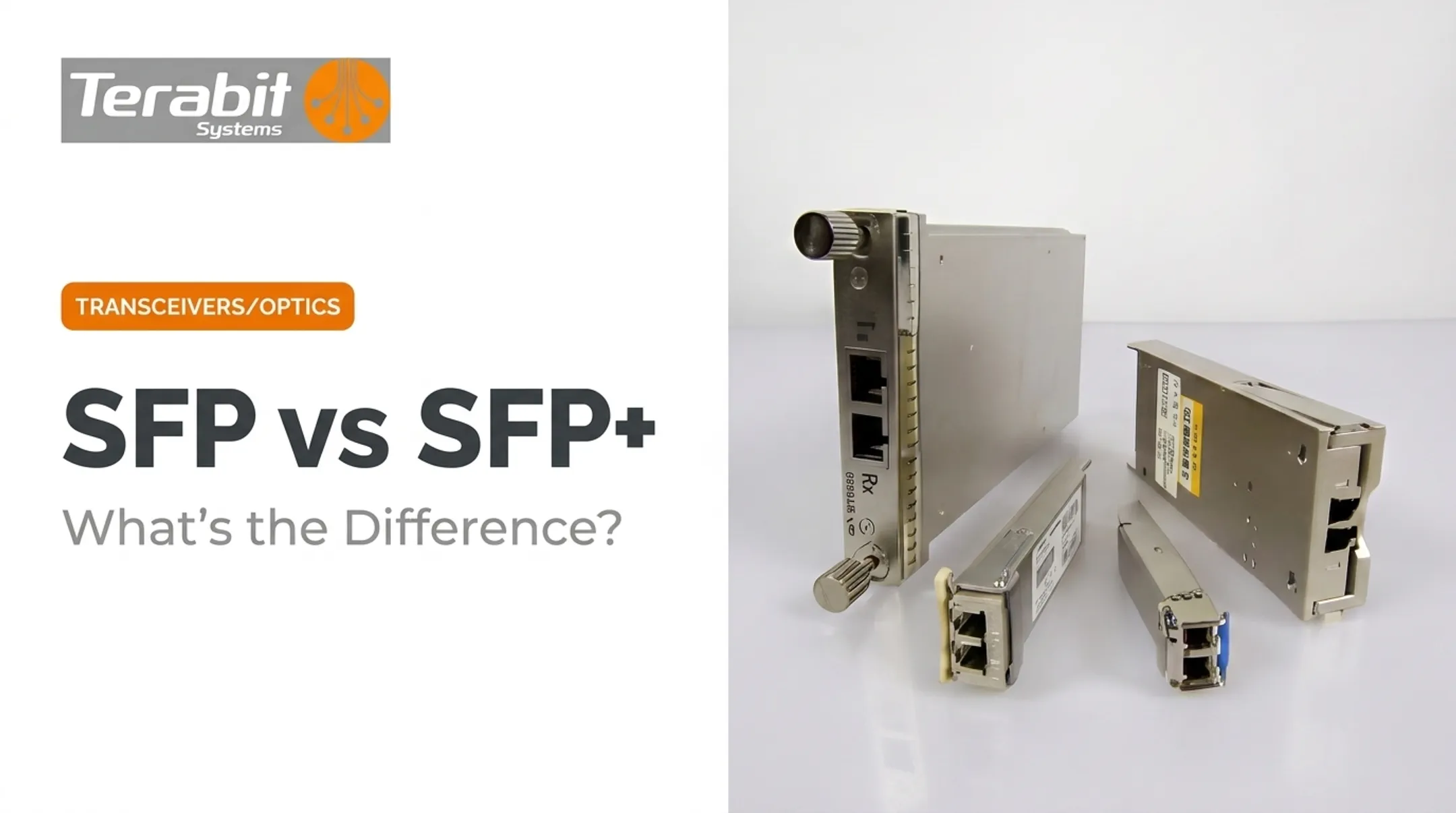
SFP stands for small form-factor pluggable, the original 1G-capable module. SFP+ is its enhanced sibling, adding 10G support inside the exact same physical footprint.
That shared footprint is the whole point. Switches with SFP+ cages will often accept legacy SFP modules and negotiate down to 1G, giving network teams flexibility during phased upgrades.
Core benefits:
- Low unit cost compared to every other form factor on this list
- Broad compatibility across switch vendors
- Simple LC connector for straightforward fiber cabling
- Copper (RJ45) options exist for short-reach, budget-friendly links
Common variants include SR, LR, ER, ZR, BiDi (bidirectional single-fiber), and DAC/AOC cable assemblies. Each targets a different reach and media type, so the "SFP+" label alone doesn't tell you everything.
Use Cases of SFP/SFP+
SFP+ remains the workhorse of existing network infrastructure. You'll find it in:
- Enterprise LANs and SMB networks needing reliable 10G uplinks
- Top-of-rack switch connections in older data center racks
- Regional ISPs plus education and healthcare networks that need 10G without hyperscaler-level spend
SFP+ is still the most widely deployed transceiver type across live networks worldwide. Plenty of production gear runs on it today, and that installed base is not disappearing anytime soon.
What Is SFP28 and QSFP28?
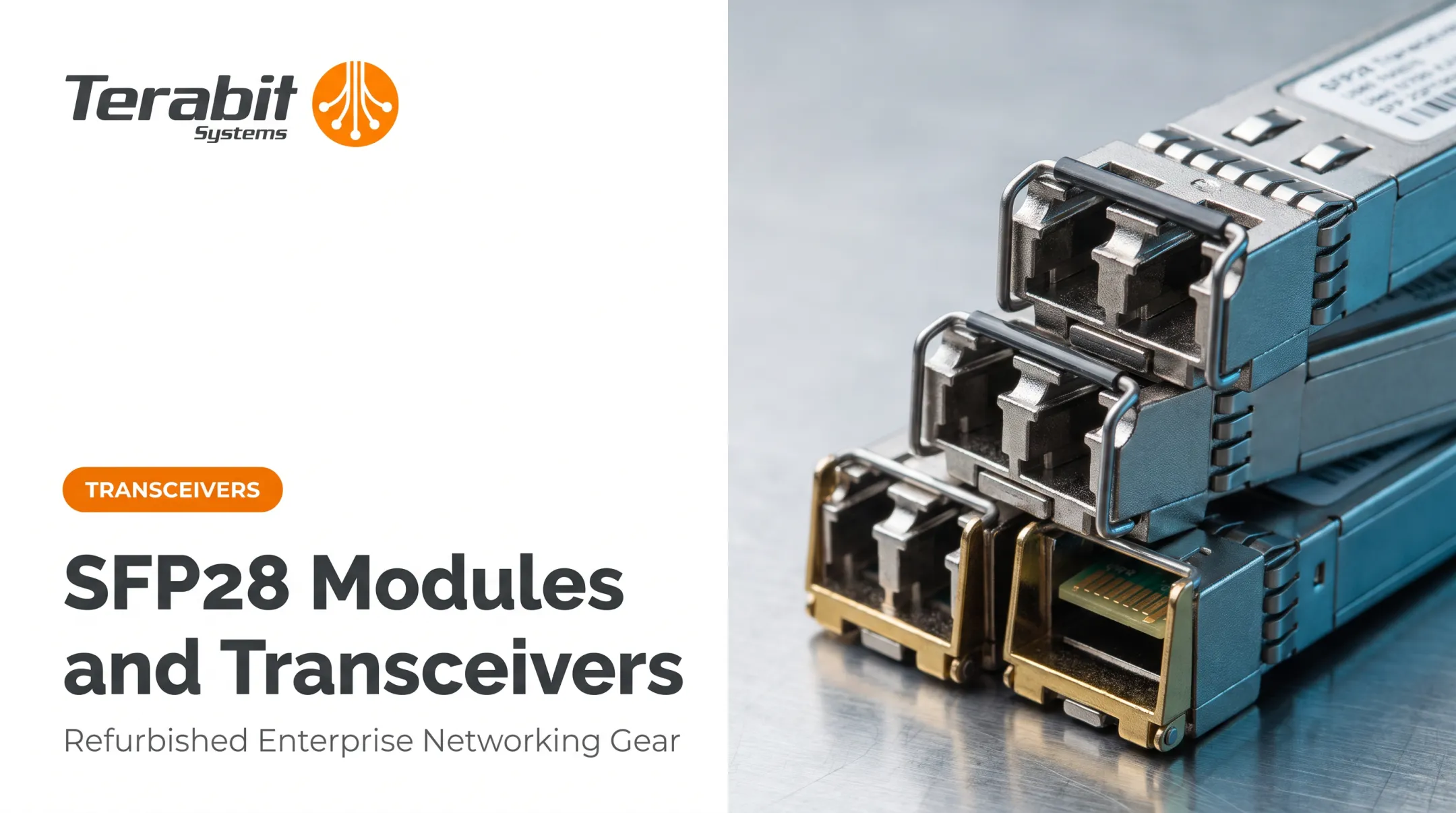
SFP28 is the 25G evolution of SFP+. It shares the identical physical footprint but upgrades the electrical interface with faster CDR (clock and data recovery) circuits. Cisco's own data sheet ties SFP28 back to the SFF-8402 standard, which specifically defines a "28 Gb/s 1x" pluggable solution.
Here's the nuance buyers miss: SFP28 is technically a 28 Gb/s signaling class, but the Ethernet service rate it delivers is 25 Gbps once you account for line coding overhead. Don't confuse the interface number with the payload number.

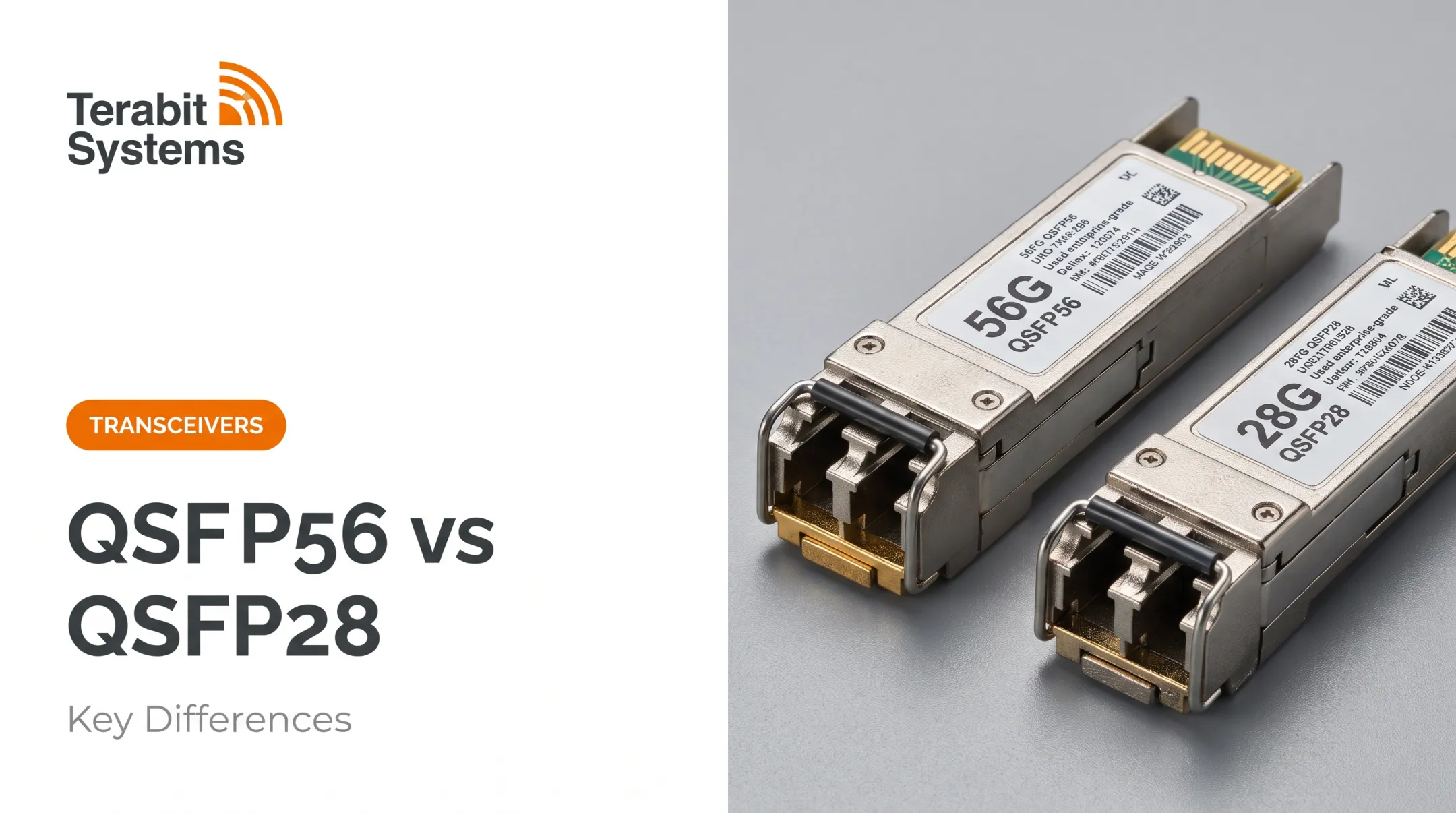
QSFP28 is a quad-lane module: four 25G channels combined to deliver 100G total. It has become the standard building block for high-speed Ethernet, InfiniBand EDR, and Fibre Channel deployments.
Core benefits:
- SFP28 delivers 2.5x the bandwidth of SFP+ without any size change to the module
- QSFP28 provides four times the port density of legacy single-lane optics
- QSFP28 uses less power per bit than older 40G optics, an efficiency win at scale
Use Cases of SFP28 and QSFP28
Typical deployments break down cleanly by lane count:
- SFP28 — 25G data center access and 5G fronthaul, where one high-speed lane per server is enough
- QSFP28 — 100G spine/leaf fabrics and hyperscale or AI cluster interconnects that need aggregated east-west bandwidth
That economics story is why 25G stuck. The Ethernet Alliance's State of Ethernet Optics report noted that 25G reuses the same hardware infrastructure as 10G and delivers 2.5x the bandwidth for less than a 2x price increase. That cost curve is a big reason 25G became "the new 10G" for server connectivity.
A concrete deployment pattern: Cisco's own design guidance describes a 100G QSFP28 switch port mapping to four separate 25G SFP28 server endpoints. That means one switch port upgrade can service four hosts, letting Tier-2 providers and cloud operators upgrade granularly instead of ripping out entire racks at once.
SFP+/SFP28 vs. QSFP28: Which Should You Choose?
Your decision hinges on five factors:
- Required bandwidth — do you need 10G, 25G, or 100G aggregate throughput?
- Port density — how many physical ports can your switch chassis support?
- Existing switch hardware — what does your current gear already accept?
- Breakout needs — do you need to split one high-speed port into multiple lower-speed connections?
- Budget — how do upfront module costs compare with long-term cost-per-bit?
Choose SFP+/SFP28 when:
- You're deploying cost-sensitive access-layer or edge connections
- Your switch hardware is already SFP+ or SFP28-native
- You need granular, per-server upgrade flexibility
Choose QSFP28 when:
- You're building core or spine links in a data center
- You're supporting AI/ML workloads with heavy east-west traffic
- You want to consolidate multiple lower-speed links into fewer, denser ports
The Compatibility Caveat
SFP28 ports will generally accept SFP+ modules, running at reduced speed through backward-compatible electrical signaling. QSFP28 is different: it is not physically interchangeable with single-lane SFP-family modules.
Cisco documents a QSA (QSFP-to-SFP) adapter that converts a QSFP+ port down to SFP/SFP+ speeds. QSFP28-to-SFP28 follows a similar four-way mapping, but only with a supported adapter or breakout cable—not a direct plug-in swap. Always confirm adapter support with your switch vendor before assuming compatibility.

Real-World Example: Cost-Effective Network Upgrades
Picture a Tier-2 cloud provider or regional ISP that needs to scale from 10G to 100G networking. East-west traffic is climbing, customers are demanding more bandwidth, and the existing 10G SFP+ infrastructure is starting to choke.
The challenge: OEM pricing on new QSFP28 switches and SFP28 optics is steep. For smaller providers competing against hyperscalers, that capital outlay can crowd out other priorities, like customer acquisition or service expansion.
Industry cost estimates cited in a Data Center Knowledge report on 100GbE adoption put 25G/100G equipment at 20-30% higher NIC cost and up to 50% higher switch-port cost compared to 10G/40G gear. That's before factoring in optic pricing.
The alternative path: source certified refurbished SFP28 and QSFP28 transceivers and switches instead of buying new OEM equipment across the board. Properly tested modules keep reliability intact and free capital for growth instead of locking it into optics.
The takeaway: tested refurbished SFP28/QSFP28 optics let growing networks hit 25G/100G without hyperscaler-sized budgets.
Terabit Systems runs refurbished SFP28 and QSFP28 modules through a five-step quality assurance process, including functional testing with live network traffic through each unit, then certifies them for resale with warranty coverage—so providers can upgrade bandwidth without the full OEM price tag.

Conclusion
No single form factor wins every design. SFP and SFP+ still fit legacy networks and budget-conscious 1G/10G builds. SFP28 and QSFP28 take over when you scale toward 25G and 100G—especially for east-west data center and AI workloads.
Match the transceiver to your real bandwidth needs and the switch hardware you already run. QSFP28 on a 10G access edge wastes budget; SFP+ on a spine that needs more capacity creates the same problem in reverse.
Tested, warrantied refurbished optics stretch that budget further at every tier—so you can buy the speed you need without paying new-OEM premiums.
Frequently Asked Questions
Is SFP28 compatible with QSFP28?
No. QSFP28 is quad-lane and SFP28 is single-lane, so the form factors differ. A QSA-style adapter can convert some QSFP28 ports to accept SFP28 modules, but confirm vendor support first.
What speeds does SFP28 support?
SFP28 supports 25Gbps natively as its Ethernet service rate, though the underlying interface class is rated at 28Gbps. It's also backward compatible with 10G when an SFP+ optic is used in the same port.
What is the main difference between SFP and QSFP+?
SFP is single-lane, topping out around 1.25Gbps for Gigabit Ethernet. QSFP+ uses four lanes for a combined 40Gbps. They're physically and electrically incompatible without an adapter.
Is SFP+ faster than RJ45?
SFP+ (10Gbps) is generally faster than standard copper RJ45 ports, which typically run at 1G or 10GBASE-T. 10GBASE-T SFP+ copper modules also exist, delivering 10G over RJ45 up to 30 meters on Cat6A or better.
What does SFP28 stand for?
It stands for Small Form-factor Pluggable 28, referencing the 28Gbps signaling rate defined by the SFF-8402 standard. The actual Ethernet data rate delivered is 25Gbps after coding overhead.
Can I use a used or refurbished transceiver safely in production networks?
Yes—when sourced from a reputable reseller with documented testing, live traffic verification, and a written warranty. Terabit Systems backs refurbished optics with a first-year replacement or refund guarantee after a five-step QA process.