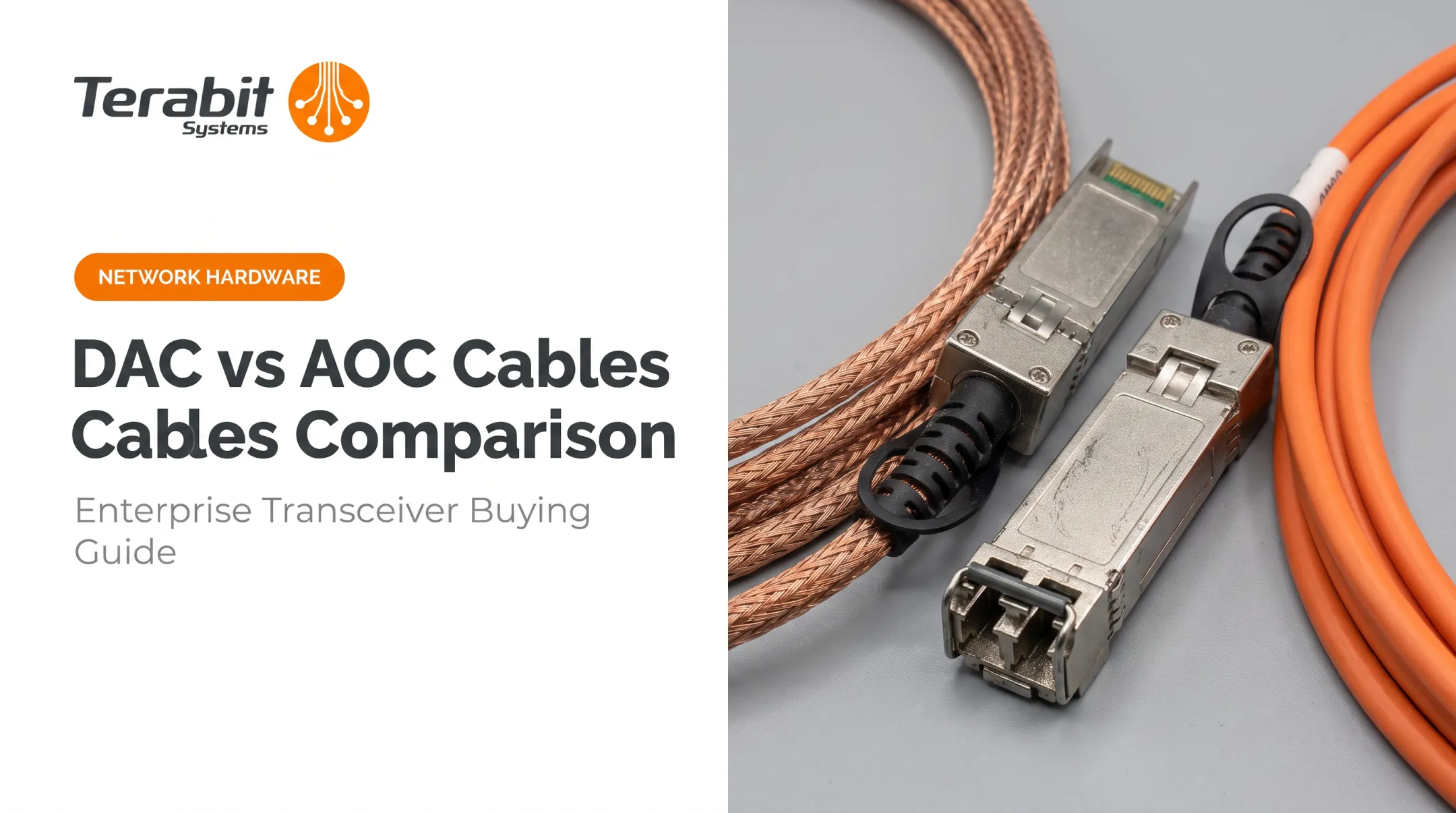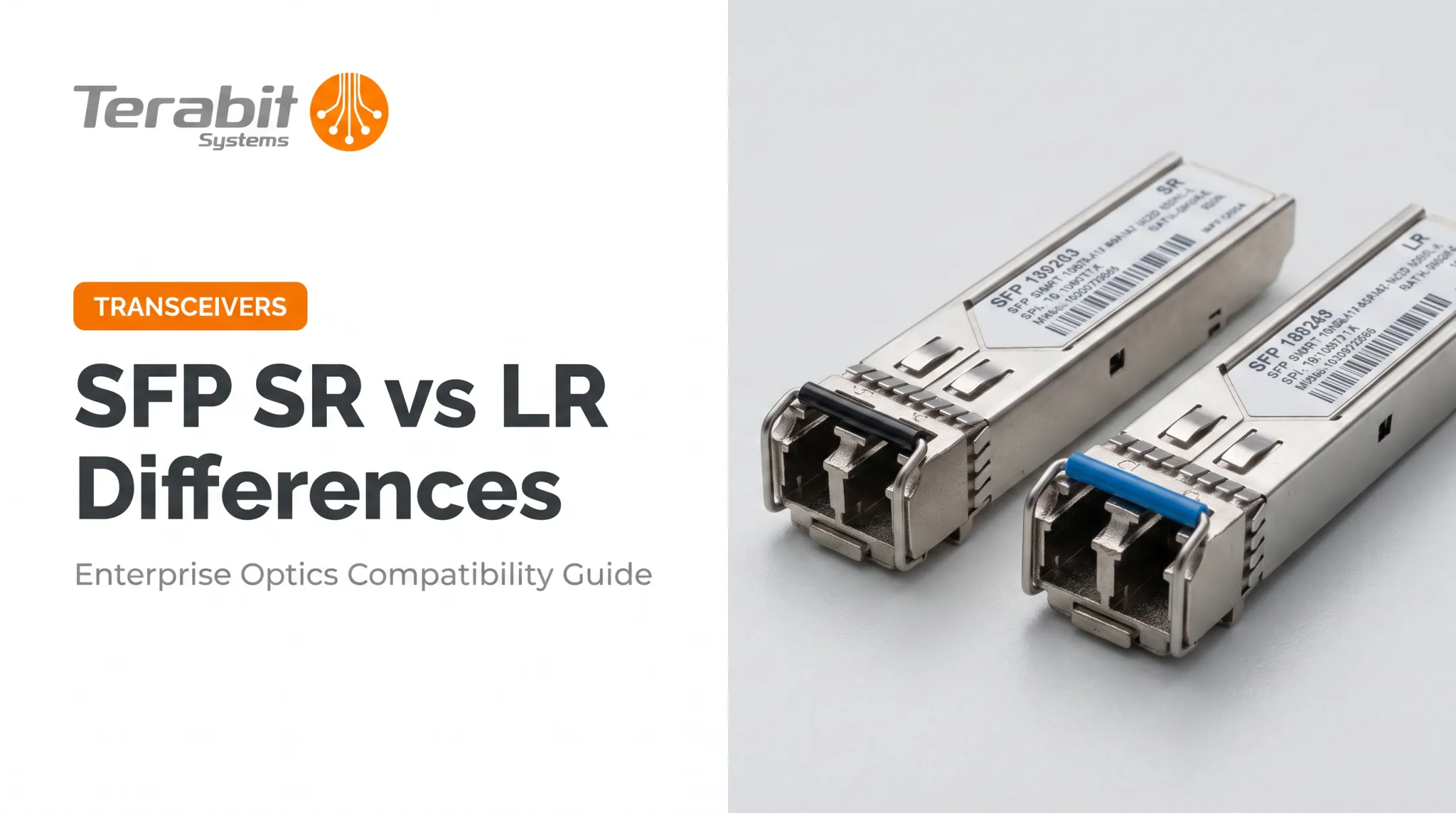

The decision affects your budget, power bill, rack density, and how easily you can scale. This guide breaks down the technical differences, real-world use cases, and how to choose without blowing your capital budget.
TL;DR
- Choose DAC cables for short copper Twinax runs under 10 meters when low cost and low power matter most
- Use fiber (optical transceivers plus patch cables) when you need tens of meters up to 40+ kilometers
- Decide on distance, budget, and scalability—not a blanket “which is better”
- Lower either path’s spend with refurbished DAC cables and optics from resellers like Terabit Systems
DAC vs Fiber: Quick Comparison
| Factor | DAC | Fiber |
|---|---|---|
| Cost | Lower upfront (no optical components) | Higher (transceiver + separate cabling) |
| Distance | Passive DAC maxes out around 7 meters; active DAC reaches 10 meters or more (Juniper) | 100G LR4 hits 10 km; ER4L reaches 40 km with FEC (Cisco) |
| Power | Near 0W passive (no active components); active DAC still well below optics | 10G optics draw 1-1.5W; 100G SR4 draws 3.5W (Cisco) |
| Flexibility | Fixed cable-plus-connector assembly | Modular: swap transceivers independently of cabling |
| Signal type | Electrical, over copper Twinax | Optical, via laser/photodetector through glass fiber |

What Is a DAC Cable?
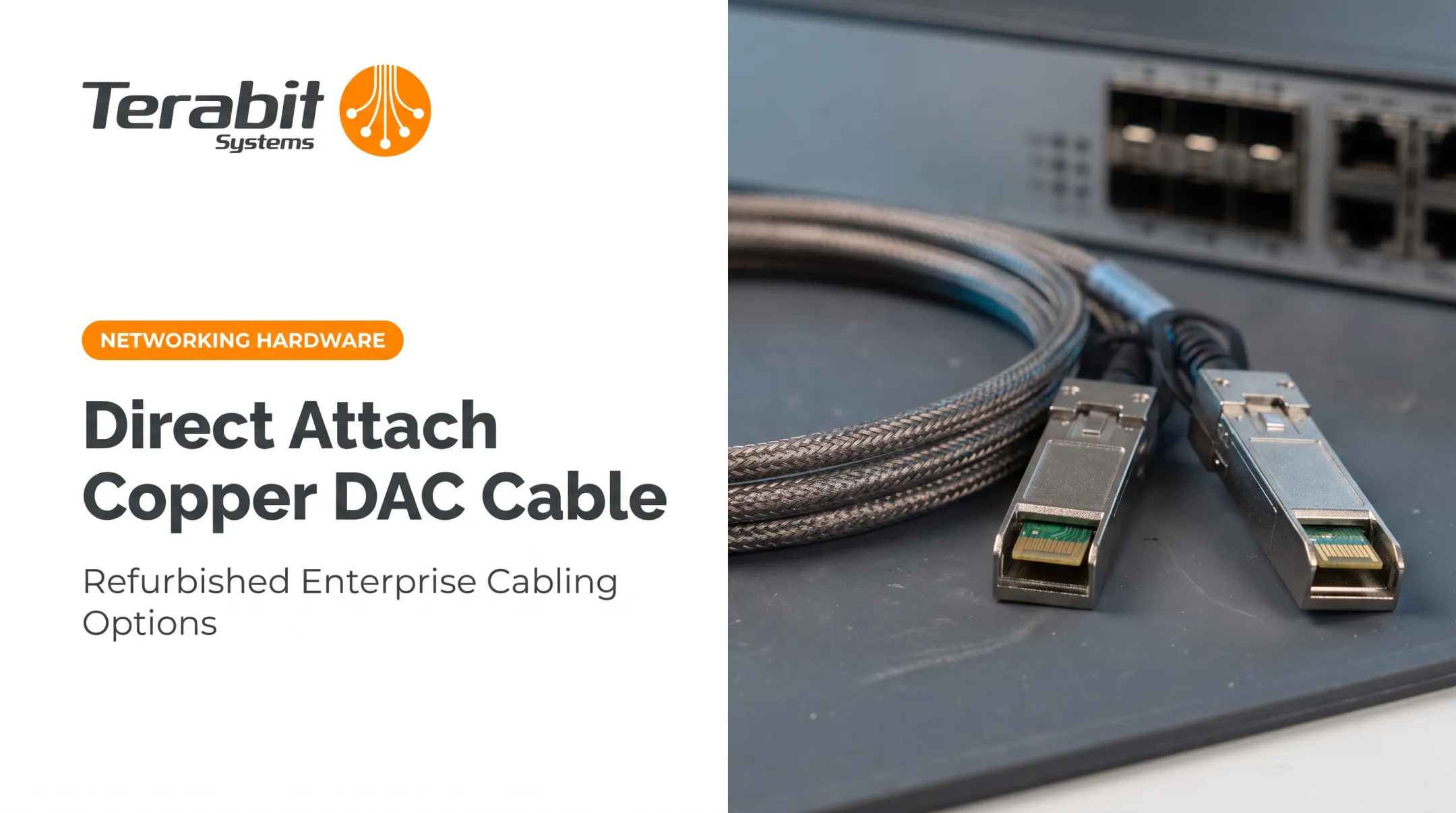
DAC (Direct Attach Copper) is a fixed assembly: a transceiver housing built into each end, connected by copper Twinax wiring in between. No separate optic to buy, no patch cable to route. It's designed for short, rack-to-rack or server-to-switch links where distance isn't a concern.
Why teams choose DAC:
- Lower latency than optical alternatives
- Minimal power draw — passive versions carry no active signal-conditioning electronics
- Less heat generated per link
- Lower total cost per connection
There are two flavors worth knowing:
- Passive DAC — no signal-boosting components, shortest reach (around 7 meters max)
- Active DAC — adds a driver chip to condition the signal, stretching reach to 10 meters or beyond
Broadcom's guidance on its Tomahawk 5 switches notes that passive DAC adds no latency beyond the speed of light. It also calls passive DAC the lowest-power option for short-range connectivity.

Use Cases of DAC
DAC shows up most often in:
- Top-of-rack connections — switch-to-server links within the same rack or an adjacent one
- Tier-2 cloud and ISP deployments — where budget and port density matter more than reach
- High-density leaf-to-leaf links — Cisco specifically calls its 100G-to-4x25G DAC breakout a cost-effective option for very short connections
When you need those short-reach links without OEM list pricing, Terabit Systems stocks Juniper's EX-SFP-10GE-DAC line in 1m, 3m, 5m, and 7m lengths (MSRPs ranging $150 to $300), plus Cisco QSFP-H40G-CU3M 40G cables—all tested and under warranty, at a fraction of buying new from the OEM.
What Is Fiber Cabling?
Fiber connectivity uses two components: an optical transceiver (SFP+, QSFP28, QSFP-DD, and similar form factors) at each end, plus a fiber patch cable between them. Unlike DAC's fixed assembly, you can swap the transceiver without touching the cable. That modularity matters as speeds increase.
Why teams choose fiber:
- Long-distance reach, from tens of meters to tens of kilometers
- Immunity to electromagnetic interference
- Upgrade path: swap in a faster transceiver as your network grows, keep the same fiber plant
Two fiber types cover most deployments:
- Multimode (OM3/OM4) — shorter optical runs, common in-building or in-row
- Singlemode (OS2/SMF) — long-haul or backbone links, tens of kilometers
Use Cases of Fiber
Fiber dominates anywhere DAC physically can't reach:
- Backbone and inter-building links spanning well over 100 meters
- Campus and telecom networks connecting separate facilities
- Regional ISP and enterprise data center deployments planning for future bandwidth growth
The bandwidth math backs this up. Cisco's 400G QSFP-DD portfolio spans 30m on OM3 multimode up to 10km on singlemode, while its 800G OSFP data sheet lists options from 30m multimode to 2km on SMF.

As the Ethernet Alliance notes, 800G delivers twice the bandwidth of 400G, and 800G optics are expected to become standard as cloud bandwidth demand keeps climbing. On a 400G or 800G roadmap, fiber is the only practical path forward.
DAC vs Fiber: Which Should You Choose?
Four factors drive this decision:
- Distance requirement: anything beyond 10 meters rules out DAC entirely
- Budget constraints: DAC wins on per-link cost when distance allows it
- Power and cooling limits: passive DAC sips power; high-speed optics draw far more
- Scalability plans: if you're migrating toward 400G/800G, fiber's modularity pays off later
The practical answer: use DAC for same-rack, cost-sensitive, high-density connections. Use fiber for inter-rack, inter-building, or anything on a long-term scalability roadmap.
Most real-world networks don't pick one. They run a hybrid model: DAC within racks where geometry is fixed and short, fiber for backbone and cross-row links where reach or future flexibility matters.

Here's where cost-conscious buyers save the most:
- Source refurbished, tested DAC cables and optical transceivers — Terabit Systems runs a five-step QA process on every unit and backs it with a one-year replacement-or-refund warranty
- Buy only what you need today instead of overbuying "future-proof" optics
- Use trade-in and asset recovery to offset DAC-to-fiber shifts; Terabit Systems evaluates surplus Juniper, Cisco, Arista, or Brocade gear for fair-market value or credit
Neither path locks you in permanently. Networks evolve, and secondary-market pricing on DAC and fiber hardware makes course corrections far cheaper than buying new from the OEM each time.
Conclusion
Neither DAC nor fiber is universally better. The right call comes down to distance, budget, and how your network needs to scale over the next few years. Get the architecture right first, then optimize for cost.
Choosing correctly cuts both capital and operational costs. Sourcing refurbished, warrantied hardware — whether DAC cables for your rack or fiber transceivers for your backbone — stretches those savings even further for Tier-2 providers and ISPs working with tight budgets.
Frequently Asked Questions
Are DAC cables worth the cost?
Yes, for short-distance, high-density connections. DAC's low cost and minimal power draw deliver strong ROI within a rack or between adjacent racks, but it isn't built for longer runs.
Is fiber better than DAC?
Not inherently. Fiber is necessary for distances DAC can't reach, while DAC stays more economical for short links. The right choice depends on your specific distance and budget needs.
What are the differences between fiber SFP and DAC?
SFP-based fiber connections use a separate transceiver and patch cable, letting you swap either component independently. DAC integrates the transceiver and cable into one fixed assembly.
Is a DAC fiber or copper?
DAC stands for Direct Attach Copper. It uses twinax copper wiring, not optical fiber, which is why it's limited to shorter distances.
What is a DAC cable used for?
DAC cables handle short-distance, high-speed connections, such as server-to-switch or switch-to-switch links within the same rack or an adjacent one.
How can I reduce costs when deploying DAC or fiber networking hardware?
Sourcing rigorously tested, warrantied refurbished DAC cables, transceivers, and fiber components cuts costs significantly compared with buying new from OEMs. Trade-in credit on surplus gear can offset upgrade costs further.