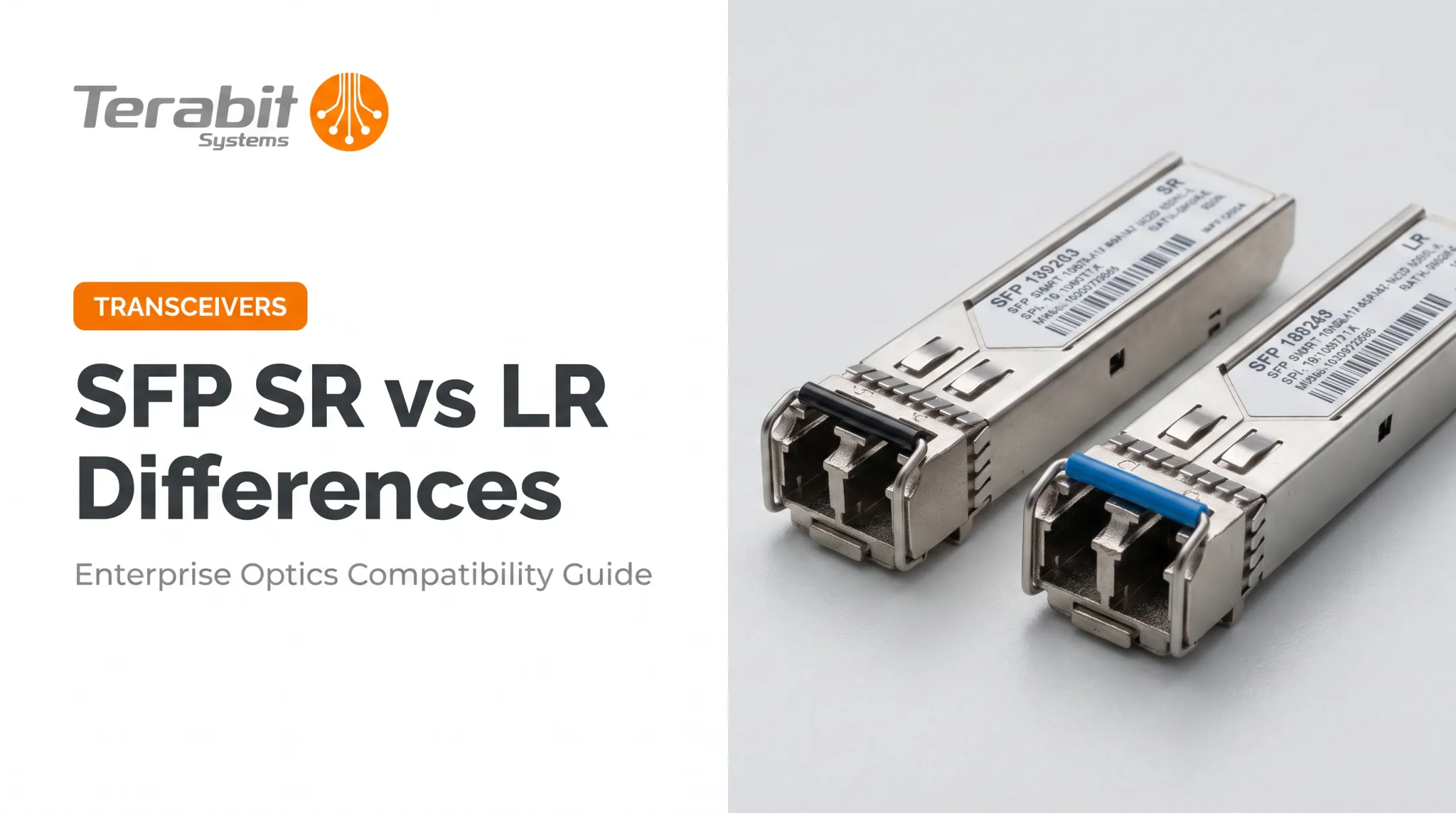

Both optics push 100G traffic over single-mode fiber for 10km. That's where the similarity ends. LR4 splits the signal across four wavelengths using NRZ modulation. LR uses one wavelength carrying the full 100G load via PAM4. That architectural difference ripples into cost, host compatibility, and how easily you can migrate toward 400G later.
This guide breaks down the technology, where each optic fits in real deployments, and how refurbished LR4 QSFP28 modules factor into a smart procurement strategy.
TL;DR
- LR4 multiplexes four 25G wavelengths (~1295-1309nm) via WDM onto duplex SMF: mature and widely compatible
- LR (Single Lambda) carries 100G on one PAM4 wavelength (~1304.5-1317.5nm): fewer optical components and different FEC requirements
- Both reach 10km over duplex SMF with LC connectors under IEEE 802.3 standards
- LR4 remains the safer bet for existing QSFP28 fleets; LR fits newer hardware built for single-lambda architectures
LR4 vs LR: Quick Comparison
| Factor | 100GBASE-LR4 | 100GBASE-LR (Single-Lambda) |
|---|---|---|
| Modulation | NRZ across four lanes | PAM4 on one wavelength |
| Wavelengths | Four channels, ~1295-1309nm | Single band, ~1304.5-1317.5nm |
| Component count | Higher (WDM mux/demux hardware) | Lower (single optical path) |
| FEC | Not required in the LR4 optical spec | Module-side RS(544,514) FEC (vendors label KP1 vs. KP4 inconsistently) |
| Host requirement | QSFP28, works with standard 4x25G electrical lanes | Needs PAM4-capable host support; not drop-in with legacy modules |
| Migration path | Standard for existing 100G rollouts | Better alignment with future 400G/SFP112 platforms |
| You'll sometimes see "LR1" used for Single-Lambda LR. IEEE's formal name is 100GBASE-LR1 (802.3cu, Clause 140). LR4 traces back to IEEE 802.3ba, Clause 88. |

What Is 100GBASE-LR4?
100GBASE-LR4 is a QSFP28 optic that takes four 25G electrical lanes and multiplexes them onto four distinct optical wavelengths (centered around 1295.56, 1300.05, 1304.58, and 1309.14 nm) for transmission over a single fiber pair. It reaches at least 10 km on standard G.652 single-mode fiber using duplex LC connectors.
LR4 has been in the standard since 2010, so major OEM platforms have had more than a decade to settle interoperability.
Why it's still the default choice for many buyers:
- Broad qualification across Cisco, Juniper, and Arista switch and router platforms
- Proven field reliability across countless production networks
- No ambiguity around FEC handling: the optical spec itself does not require it
One documentation quirk: vendor materials sometimes use "LR1" loosely, which can get confused with the formal Single-Lambda LR1 standard. Always confirm the exact part number and standard compliance before ordering.
Where LR4 Still Fits
LR4 shows up wherever 10 km reach is needed without introducing new host requirements:
- Data center leaf-spine and DCI links between spine switches or across campus facilities
- Telecom aggregation and WAN/MAN backbones, where refresh cycles are slower and compatibility beats component count
- Enterprise campus cores on long building-to-building or site-to-site runs
For cost-conscious buyers, refurbished LR4 QSFP28 modules from Cisco, Juniper, and Arista are a practical way to deploy proven 100G links without full OEM new-unit pricing. Terabit Systems stocks tested, warrantied units for teams managing large port counts, where modest per-unit savings add up fast.

What Is 100GBASE-LR (Single Lambda)?
100GBASE-LR (more precisely, 100GBASE-LR1) carries the full 100G load on a single PAM4-modulated wavelength instead of splitting the signal across four. Cisco documents this band as roughly 1304.5 to 1317.5 nm, over the same 10 km duplex SMF and LC connector setup as LR4. Fewer components, different tradeoffs:
- Simpler internal optical design with no WDM mux/demux hardware
- Better long-term manufacturability at scale
- Smoother upgrade path toward 400G, since single-lambda architecture is the direction 400G and beyond are headed The catch: single-lambda LR relies on module-side FEC. Cisco documents this as RS(544,514), also labeled KP1 or KP4 in different materials, so naming is not fully consistent across vendors. That shifts more error-correction work onto the module instead of the host ASIC. Not every legacy QSFP28 host pairs cleanly with that architecture.
Use Cases of LR (Single Lambda)
Single-lambda LR is best suited to:
- Newer switches and NICs built for single-lambda optics, in data center and DCI roles
- Emerging SFP112-class platforms aimed at higher faceplate density
- Staged service-provider upgrades that bridge new 400G-capable sites to existing 100G infrastructure Cisco's solution overview documents operators using single-lambda 100G this way; treat it as vendor rationale, not independent market data. If you are planning a phased move to 400G, hardware that already supports single-lambda optics avoids a second forklift upgrade later.

LR4 vs LR: Which Should You Choose?
The decision comes down to four factors:
- Host FEC support — does your switch or NIC support KR4-style FEC (LR4-friendly), or the PAM4/module-side FEC that Single-Lambda LR needs?
- Budget — LR4's maturity typically means more competitive pricing on the refurbished market, due to volume and age of the standard
- Upgrade roadmap — if 400G is on your three-year plan, single-lambda architecture may save you a migration step
- Fiber infrastructure — both use duplex SMF with LC connectors, so this rarely differentiates them; still confirm your plant matches
Quick recommendation:
- Choose LR4 if you're working with existing QSFP28 KR4-FEC switches and want proven compatibility at a lower per-unit cost
- Choose Single-Lambda LR if your hardware already supports KP4/module-side FEC and 400G is on your near-term roadmap
Not sure which camp your current equipment falls into? That is a common problem, and a surplus audit is built for it.
Terabit Systems offers a free audit of surplus or planned network gear. It confirms whether your switches and NICs support LR4 or need Single-Lambda LR modules before you commit to a purchase.
Real-World Example
Consider a Tier-2 cloud provider expanding its 100G interconnect capacity. Link costs are climbing, and the network team isn't fully certain which optic type its existing switch inventory actually supports: some racks are older QSFP28 gear, others were purchased more recently.
The approach that avoids costly mistakes:
- Audit existing switches for FEC support (KR4 vs. KP4/module-side)
- Confirm which optic type matches each rack's actual capability, not just what the port physically accepts
- Source tested, refurbished LR4 QSFP28 modules for the legacy racks that don't support single-lambda PAM4
- Reserve any single-lambda LR purchases for newer hardware already built for it

An audit-first approach prevents a common failure mode: ordering from the spec sheet, then discovering the host won't negotiate the link. Match optic type to verified infrastructure before you buy, and you avoid compatibility surprises and rework.
Conclusion
Neither LR4 nor Single-Lambda LR is the universally "better" optic. LR4 wins on proven compatibility and market maturity. Single-Lambda LR wins on component simplicity and a cleaner path to 400G.
The right call depends on what your switches and NICs actually support, what your budget allows, and where your network is headed over the next few years. That may mean cost savings with tested refurbished LR4 modules, or a move to single-lambda optics for an easier path forward.
A sourcing partner who verifies compatibility before you buy keeps the decision tied to your real infrastructure, not a spec sheet alone. Terabit Systems helps network teams source and validate the optics that match those constraints.
Frequently Asked Questions
What are the key differences between LR and LR4 optics?
LR uses a single PAM4-modulated wavelength to carry the full 100G signal, while LR4 splits the load across four NRZ wavelengths using WDM. This affects FEC requirements, component count, and host compatibility.
How does LR4 differ from DR4 optics?
LR4 uses WDM over duplex LC fiber for 10km reach. DR4 (specifically 400GBASE-DR4) uses parallel MPO fiber without WDM for 500m reach (a different distance class and connector type entirely).
Is 100G LR the same as LR1?
Yes. "LR1" is the formal name for Single-Lambda LR: one wavelength carrying 100G via PAM4. LR4 uses four NRZ wavelengths with WDM, so LR/LR1 and LR4 are not interoperable.
What is 100GBASE-LR4?
It's a QSFP28 optic using four 25G NRZ lanes multiplexed via WDM over duplex single-mode fiber, reaching at least 10km. It's defined under IEEE 802.3ba, Clause 88.
What is a QSFP 100G LR4 transceiver?
It's a hot-pluggable QSFP28 module implementing the 100GBASE-LR4 standard, letting network equipment establish 10km 100G links over standard single-mode fiber.
Can refurbished 100G LR4 modules perform as reliably as new OEM units?
Yes, when rigorously tested. Terabit Systems runs refurbished optics through physical inspection, functional traffic testing, and final QC before backing them with a one-year replacement-or-refund warranty.